







Colum Eastwood’s The Morrigan enters folk horror through a strong setup. Fiona Scott, an archaeologist studying Gaelic and Celtic mythology, travels to a remote Irish island for an excavation and brings her teenage daughter Lily with her.
The trip is tied to a burial casket and a long-buried figure linked to the Morrigan, a pagan war goddess whose release turns an academic dig into a possession story with intimate stakes. Fiona’s task shifts from professional discovery to a fight to keep Lily from slipping fully into the goddess’s control.
The film draws from a powerful mythic source. In Irish tradition, the Morrigan carries associations with war, fate, death, sovereignty, and the imagery of crows and ravens. That material carries rich dramatic potential, especially in a story that places a mother and daughter inside a male-dominated space on an isolated island.
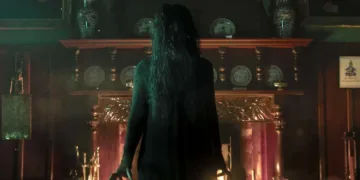
Eastwood also gives himself a vivid canvas through coastal ruins, mist, and old interiors. What follows has enough atmosphere and a few strong performances to hold attention, though the script and technical execution often pull the film toward familiar possession mechanics rather than the sharper mythic horror it hints at.
Myth, Patriarchy, and the Possession Framework
The screenplay opens with an ancient flashback tied to the titular figure, then moves into the present-day excavation plot where Fiona seeks proof that the Morrigan was a real historical person. Once the dig produces its key discovery, the story shifts into possession mode as Lily becomes the vessel for the unleashed force, pushing the film toward a volatile final stretch. The broad structure is easy to track, and Eastwood clearly wants the supernatural story to mirror a modern social order built on exclusion and control.
That thread is where the film is most interesting. Fiona is repeatedly sidelined by male academic authority, especially Jonathan Horner, who benefits from her work while limiting her agency. The film frames this as a system rather than one bad personality. Credit, access, and leadership remain in male hands even when Fiona has the insight.
In that sense, The Morrigan speaks to a global trend in horror where institutional power and domestic strain share the same dramatic space. Recent folk and psychological horror from different regions has leaned into this pattern, though Eastwood’s film grounds it in Irish myth and academic gatekeeping.
The mother-daughter dynamic gives the story its emotional engine. Fiona and Lily arrive already bruised by resentment, neglect, and poor communication. Lily’s anger has force before any supernatural turn, which helps the possession arc gain traction. The problem is depth. The script points to family wounds and an absent father, yet leaves key motivations thin.
The mythology work also feels narrowed. The crow imagery is present, and the title carries weight, but the Morrigan is often staged like a standard demonic presence. That choice reduces a complex goddess to a familiar horror function. Side plots and supporting conflicts crowd the film further, leaving several ideas half-developed.
Emily Flain Carries the Pulse of the Film
Emily Flain gives the performance that keeps The Morrigan alive through its weaker stretches. As Lily, she has a sharp physical presence that communicates impatience, contempt, hurt, and curiosity with very little dialogue. Her posture and gaze do a great deal of work in the early scenes, especially when the script sketches Lily as a rebellious teenager without always giving her enough interior detail. Flain makes that rebellion feel specific. Once possession enters the story, she remains the film’s strongest source of momentum.
Saffron Burrows has a harder assignment as Fiona, since the character is written as the story’s emotional anchor and principal point of view. Burrows plays her with a controlled, worn-down reserve that fits a scholar fighting for legitimacy while trying to manage a strained relationship with her daughter.
There is a plausible reading of Fiona as a woman whose emotional bandwidth has been depleted by years of professional obstruction. At the same time, the performance can feel too muted in scenes that need urgency, fear, or maternal panic, which weakens a few central confrontations.
The supporting cast is mixed in a useful way. Toby Stephens brings a calm, welcoming surface to Malachy, James Cosmo gives Father Francis authority, Art Parkinson adds a gentle and tense presence as Sean, Jonathan Forbes makes Horner effectively abrasive, and Michael Shea’s Conor supplies a grounded reaction to the chaos. Several performers create texture within limited screen time.
The script, though, often treats characters as thematic positions. Men can read as embodiments of hostility more than fully shaped people, and some emotional beats register as strong moments rather than complete arcs.
Fog, Shadows, and a Film at War With Its Own Craft
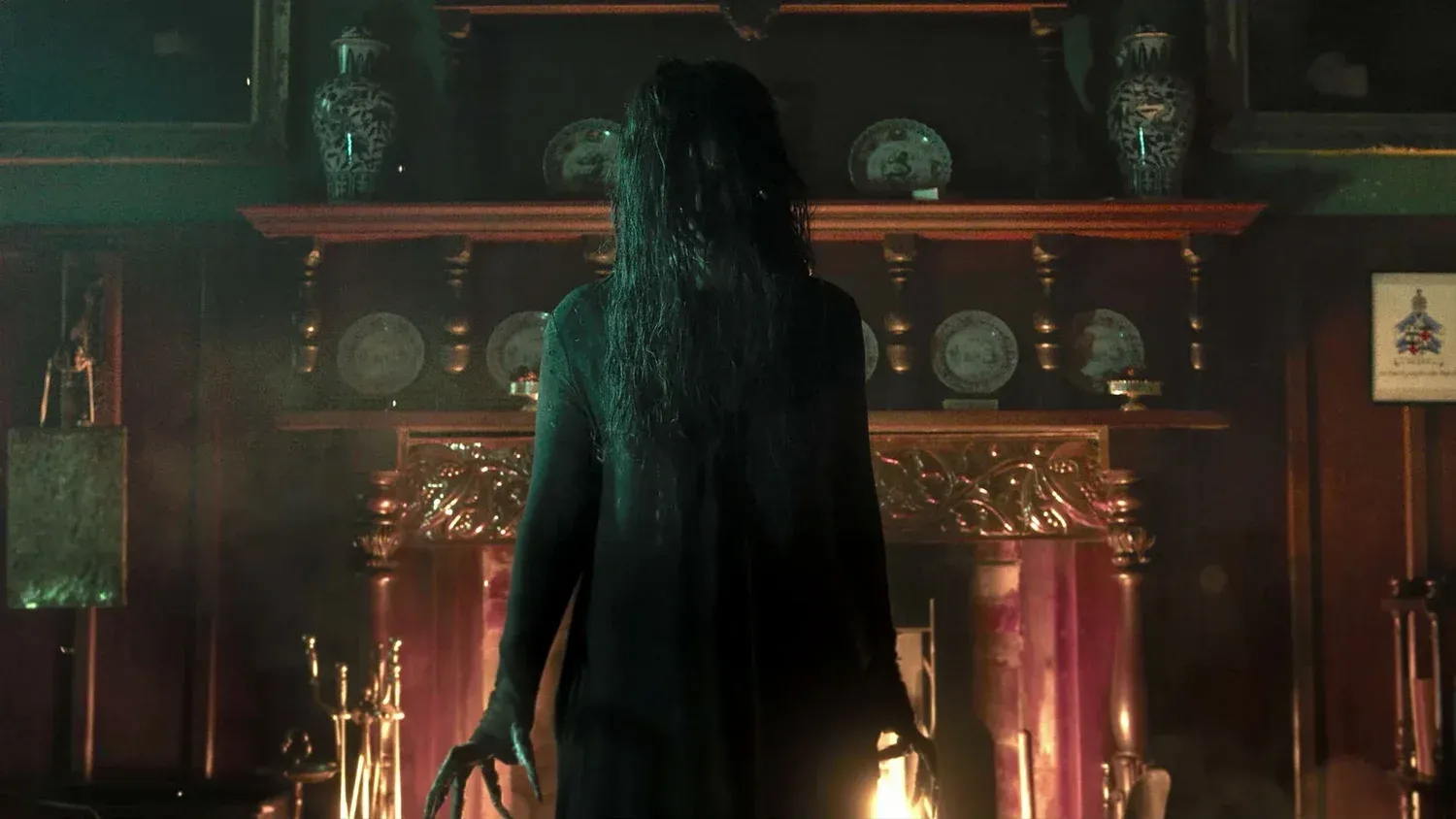
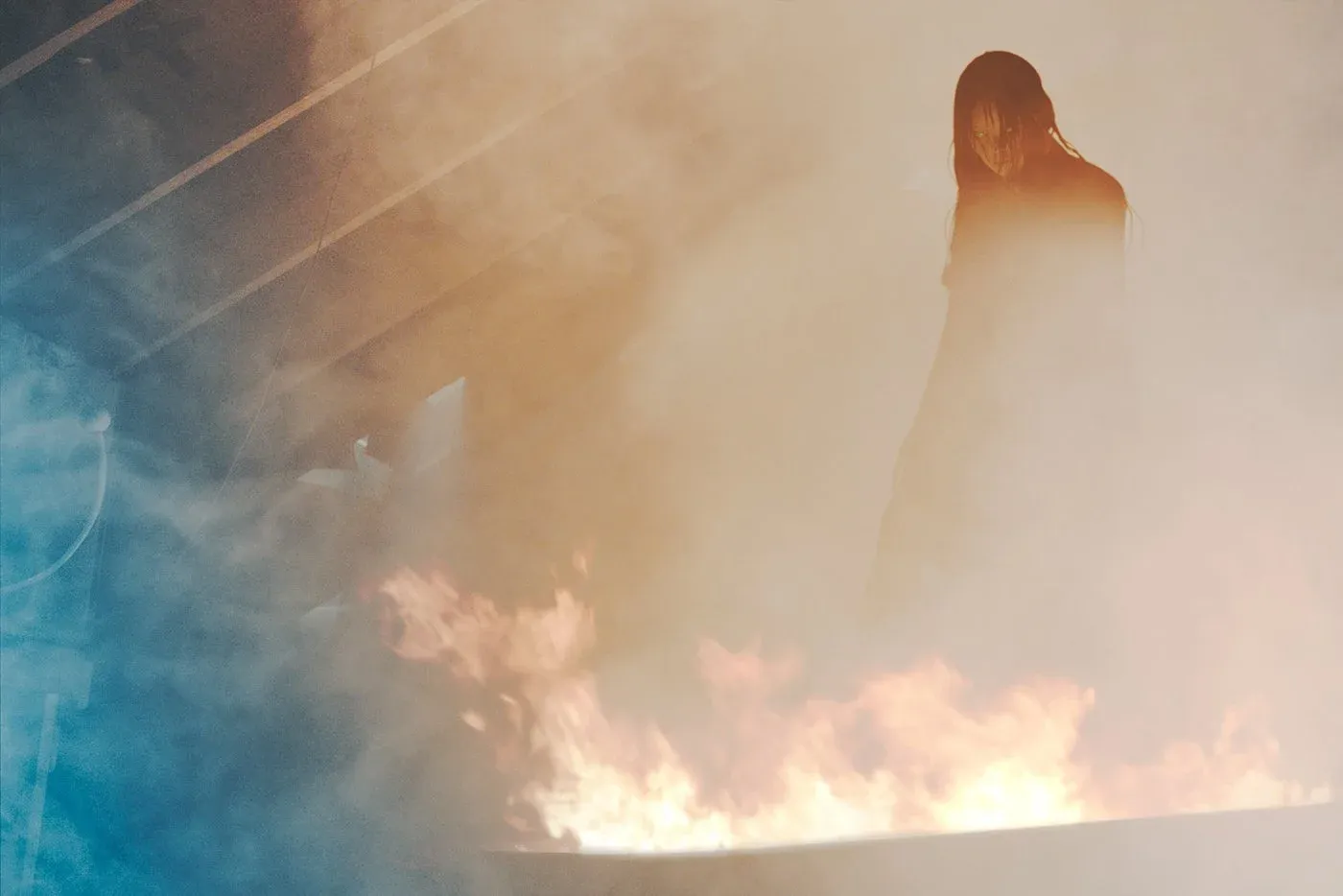
As a folk horror setting, The Morrigan starts from a place of real strength. The remote island location, cliffs, fog, inn interiors, ruins, and underground spaces give the film a built-in sense of isolation. Eastwood understands how to place figures inside these landscapes, and the production gains a moody texture from stone walls, dim rooms, and coastal weather. In another version of the same film, these ingredients could produce a more unsettling and distinct experience.
The cinematography aims for heavy shadow and low light, which suits the genre in principle. The issue is legibility. Many scenes are so dark that important visual information becomes difficult to parse on a home screen, and this practical viewing problem cuts into suspense. Atmosphere is present, yet tension suffers when the eye is searching for basic action.
The effects work is uneven. A few sequences have a rough, tactile energy that recalls older horror aesthetics, and there are moments where the supernatural imagery almost lands. Then the film leans into CGI and transformation choices that look distracting, especially near the end. Makeup and visual design around possession do not always support the threat level the script wants.
Editing and pacing add to the inconsistency. The film moves between long stretches of stillness and sudden bursts of violence or chaos. Some viewers may respond to that rhythm as trance-like, but several sequences feel choppy or oddly assembled, with rapid cuts that blur group dynamics rather than intensify them. By the third act, the film reaches for a larger, more symbolic horror payoff and runs into familiar possession beats, forced character decisions, and set pieces that do not fully cash in on the mythic material.
The Morrigan is a UK folk horror feature directed by Colum Eastwood, centered on an archaeologist and her teenage daughter whose trip to a remote Irish island turns into a supernatural crisis tied to Celtic mythology. The film premiered on the festival circuit in 2025, including Galway Film Fleadh, before its U.S. digital and VOD release on February 3, 2026 through Cineverse. Coverage around the release also points to availability through Bloody Disgusting and Screambox, depending on region and storefront access at the time you check. As of February 24, 2026, the most widely cited release path is digital / VOD via Cineverse.
Where to Watch The Morrigan (2026) Online









Full Credits
Title: The Morrigan
Distributor / Platform: Cineverse (Digital / VOD release), Screambox (availability referenced in coverage)
Release date: February 3, 2026 (U.S. digital / VOD release)
Running time: 96 minutes
Director: Colum Eastwood
Writers: Colum Eastwood
Producers and Executive Producers: Ashley Holberry, Gavin Cosmo Mehrtens (producers); executive producers were not clearly listed in the accessible sources I could verify
Cast: Saffron Burrows, Emily Flain, James Cosmo, Toby Stephens, Art Parkinson, Jonathan Forbes, Michael Shea, Antonia Campbell-Hughes, Sean Kearns, Nigel O’Neill, Desmond Eastwood, Celina Chien, Steven Cooke
Director of Photography (Cinematographer): Robert Binnall
Editors: Fredrik Limi
Composer: James Everett
The Review
The Morrigan
A strong Irish folk horror setup, vivid island atmosphere, and Emily Flain’s standout performance keep The Morrigan watchable, yet the film loses force through familiar possession beats, thin character writing, and uneven technical execution, especially in the later stretch.
PROS
- Strong folk horror premise rooted in Irish mythology
- Atmospheric island setting with cliffs, fog, ruins, and tunnels
- Emily Flain delivers the film’s strongest performance as Lily
- Good supporting presence from James Cosmo, Toby Stephens, and Art Parkinson
CONS
- The mythology is often reduced to a familiar possession template
- The script leaves key character motivations underdeveloped
- Several side plots compete for time and weaken cohesion
- Fiona’s arc loses impact in places because the writing and performance feel muted
- Many scenes are too dark, which hurts clarity on home viewing