














![Kingdom Hearts Collection [I-III] Review](https://gazettely.com/wp-content/uploads/2026/10/Kingdom-Hearts-Collection-I-III-1-360x180.webp "Kingdom Hearts Collection [I-III] Review: KHII Holds Steady as Newer Entries Fluctuate 33")






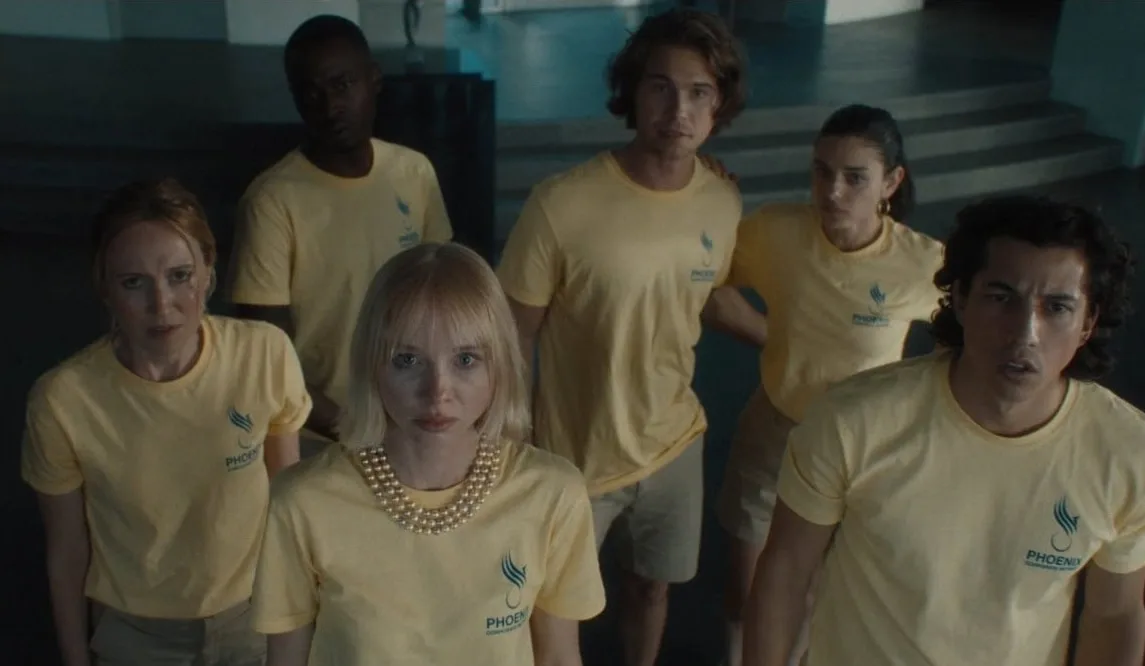

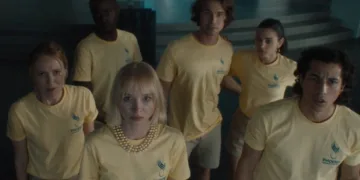
The story gathers a young, wealthy executive team from the highly valued Immaculate Pond Technologies at a luxurious desert manor for an annual team-building weekend. The event, arranged by a relentlessly cheerful human resources head, curdles the moment everyone arrives. The hosts seize every communication device, then reveal that the corporate guests have been sealed inside the compound. What began as a retreat has been redesigned as a sadistic gauntlet by the company’s vengeful, ousted founder.
Ginger, played by Odeya Rush, enters this trap from the outside. She is an abnormal psychology student, lured into the weekend by her arrogant boyfriend, Cliff, the company’s chief legal counsel. Arthur, the former CEO played by Alan Ruck, controls the ordeal through two brainwashed, armed enforcers, Lola and Amber. The film aims for workplace satire, escape-room thriller, and extreme torture horror in one bitter package, using corporate culture as a target for pitch-black comedy.
Dissecting the Narrative Blueprint
The film begins in medias res, presenting structural wreckage and a bloody aftermath before rewinding to the C-suite’s arrival. Flashy onscreen titles and arrows introduce each executive, setting up a playful, self-aware genre machine with a clean opening hook.
The script then moves from standard corporate discomfort to instant danger when the group is poisoned and forced to create an antidote from household chemicals. From there, Arthur’s strange spiritual system takes over. He calls it the seven gateways to spiritual enlightenment, a structure that turns the film into a chain of grisly trials.
That framework exposes the distance between the film’s satirical ambition and its thin story engine. The script wants to ridicule fake workplace camaraderie, polished wellness language, and the exploitative habits built into corporate life. Recent workplace horror comedies have turned capitalist exploitation into literal bloodshed with sharp results. This feature has the same appetite for corporate punishment, yet it lacks a clear point of view on greed or hierarchy. The trials mainly exist to drag characters from one gruesome set piece to the next.
The fractured structure gives the film a serious identity problem. Director Aaron Fisher never settles into a steady rhythm, moving awkwardly through campy B-movie comedy, severe psychological trauma, and plain action beats. The dialogue leans on profanity in place of wit, which leaves the dark comedy feeling blunt.
The individual challenges also miss the escalating pressure a survival story needs. Each room should tighten the narrative vise. Here, the rooms feel like separate sketches, each staged with a different level of confidence and a different idea of what movie this is supposed to be. That is a rough business model for terror.
Character Dynamics and Corporate Caricatures
Alan Ruck gives the film its sharpest performance by leaning fully into theatrical, scenery-chewing villainy. His monologue has a delusional, erratic zeal that supplies energy whenever the script starts to flatten. Ruck commits to the strange demands of the material and gives the surreal premise a streak of psychological malice.
The writing weakens Arthur’s menace through sloppy logic. He preaches spiritual transcendence through bodily torment, yet he has never taken part in the trials himself. His supposed brilliance also shrinks fast once a college student outmaneuvers him.
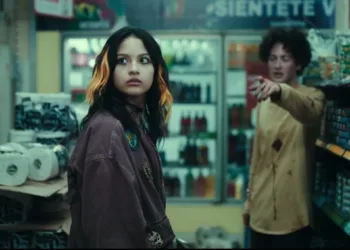
Ginger receives the clearest narrative function as the final girl. Her background in abnormal psychology gives the script a quick explanation for her survival instincts, though the characterization remains thin. Rush has a direct screen presence, and she carries herself with enough focus to sell Ginger’s place in the plot. The stiff dialogue limits the character’s impact. She has the outline of a memorable heroine, then the script forgets to color it in.
The supporting executive ensemble gets less care. Billie, the bubbly HR manager, Devin, the overly young CEO, and Rosanna Arquette’s character are left underdeveloped. Arquette’s brief appearance is a particular waste, ending almost immediately after a single spoken line.
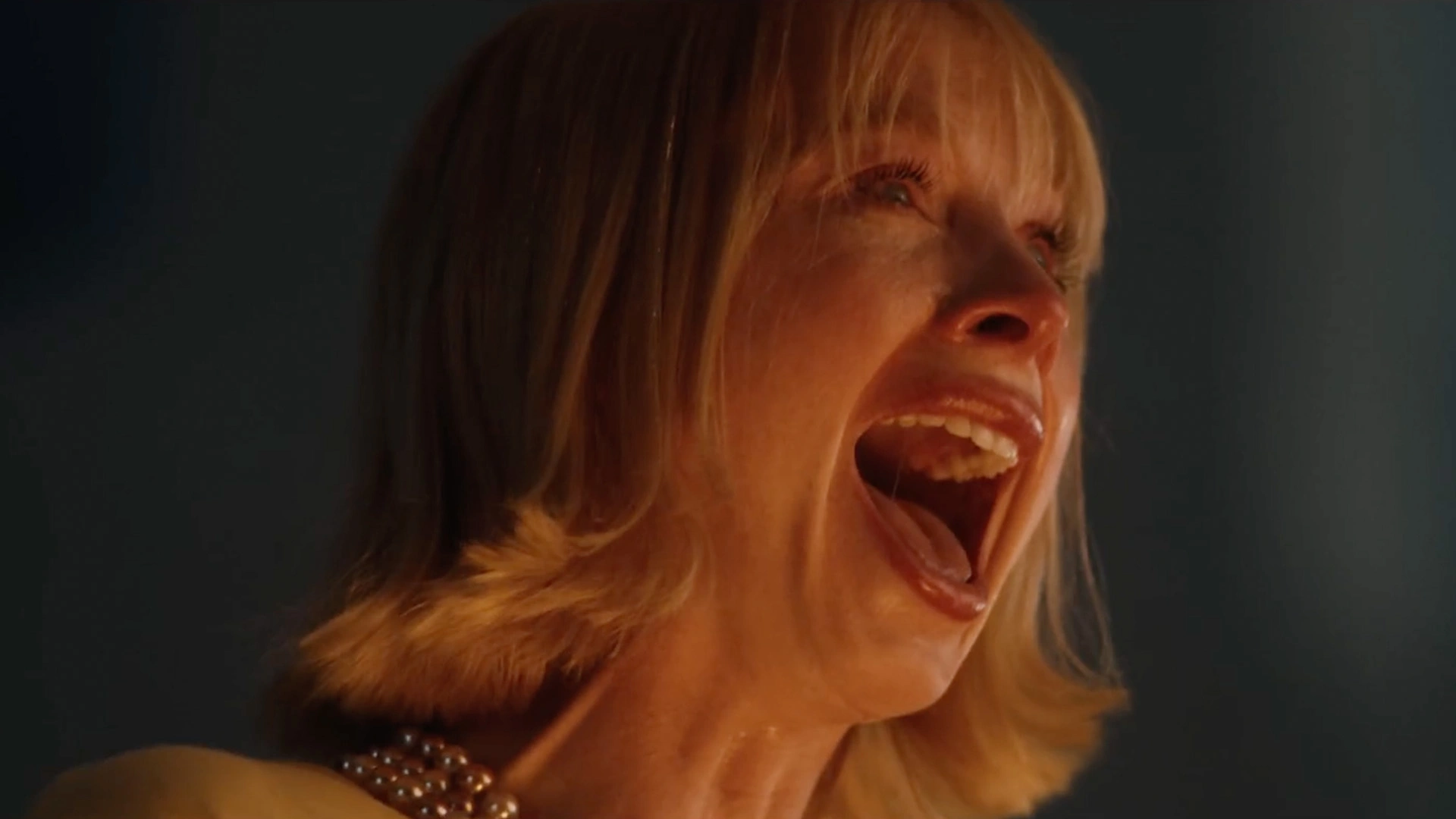
The rest of the cast struggles with flat, unnatural delivery, which makes their survival feel emotionally distant. As Lola and Amber, Sasha Lane and Zión Moreno project eerie cult obedience. Lane shows decent comic timing, yet both characters stay trapped in a repeated pattern of aiming guns at colleagues, with little inner life beyond obedience.
Visceral Realism and Technical Fractures
The production’s strongest asset is its graphic practical gore. The film includes scenes of self-mutilation, stabbing, and anatomical dissection that display serious technical skill. A five-minute sequence built around the detailed removal of an eyeball with a spoon is staged with shocking, agonizing realism. The camera stays close to every wet, painful detail, pushing discomfort as far as the scene can carry it. Since the characters remain thin, the violence gradually loses dramatic force. It shocks the body, then leaves the story behind.
Those practical effects are far sturdier than the surrounding visual craft. Shaky camerawork, careless blocking, and muddy, underlit interiors damage the presentation. Frames often cut off faces and key physical details without a clear visual purpose, creating the sense of haste rather than design.
The geography creates another problem. Establishing drone shots clash with the script’s repeated claim that the compound is completely isolated, since the aerial footage shows ordinary suburban neighborhoods around the mansion. That coordination failure reaches the final act, which collapses into an amateurish shootout with unconvincing digital muzzle flashes and awkward actor movement from performers unable to simulate weapon recoil.
The direction also reaches for the cool, stylized confidence of classic independent cinema through 1960s surf guitar music and dramatic title cards. The choices read like borrowed signals from stronger films. By the end, the intended style has curdled into the look of a messy student film.
The satirical horror-thriller Corporate Retreat was released wide in theaters across the United States on May 22, 2026, following promotional buyer screenings at the Cannes Marché. Audiences can currently experience the bloody, team-building gauntlet exclusively on the big screen during its domestic theatrical run via Western Film Service.
Where to Watch Corporate Retreat (2026) Online





Title: Corporate Retreat
Distributor: Western Film Service
Release date: May 22, 2026
Rating: R
Running time: 1 hour 30 minutes
Director: Aaron Fisher
Writers: Aaron Fisher, Kerri Lee Romeo
Producers and Executive Producers: Uri Singer, Ali Jazayeri, Viviana Zarragoitia, Lucas Jarach, Stefan Klink, Jack Fisher
Cast: Alan Ruck, Rosanna Arquette, Odeya Rush, Sasha Lane, Ashton Sanders, Elias Kacavas, Benjamin Norris, Zión Moreno, Tyler Alvarez, Ellen Toland, Kirby Johnson
Director of Photography (Cinematographer): Peter Sova
Editors: Claudia S. Castello
Composer: Anna Drubich
The Review
Corporate Retreat
Corporate Retreat attempts to merge sharp corporate satire with grueling survival horror, but the narrative machine stalls due to tonal confusion and flat characterization. Outside of Alan Ruck’s delightfully unhinged performance and some exceptional practical effects, the amateurish technical execution and shoddily constructed plot leave the film feeling hollow. It is less of a cohesive commentary and more of a disjointed, mean-spirited exercise in empty shock value.
PROS
- Fully commits to a theatrical, chaotic villainy that injects much-needed energy into the film.
- Visceral, expertly crafted special effects that genuinely make the audience squirm, particularly during the central ocular sequence.
CONS
- Awkwardly shifts between campy dark comedy and graphic psychological torment without settling on a stable identity.
- Marred by careless blocking, muddy lighting, glaring geographical errors, and artificial CGI muzzle flashes.
- The supporting cast consists of unlikable, underdeveloped corporate caricatures whose fates carry no narrative weight.