





























The cinematic reckoning with 20th-century German history often loves a wide shot of wreckage: avenues flattened, capitals shivering, ideology written in masonry dust. Volker Schlöndorff’s Visitation, adapted from Jenny Erpenbeck’s acclaimed 2008 novel Heimsuchung, narrows the aperture with almost forensic calm. The film fastens itself to a few acres of lakeside property in Brandenburg, near Berlin. A restful patch of land becomes a witness box, absorbing seventy years of state-sponsored trauma until the soil itself starts to look subpoenaed.
The timeline moves from the rise of national socialism through the tragedy of the Holocaust, then into Soviet military occupation, life inside the German Democratic Republic, and the fall of the Berlin Wall. The choice of one fixed site keeps the film restrained and precise. Macro-politics appear as property lines, legal transfers, summer houses, closets, garden beds. The project tries to compress a century of guilt, fantasy, opportunism, and idealism into the ground beneath a quiet retreat. That is a dangerous compression. It is also the film’s wager.
Shifting Soil and Sovereign Shadows
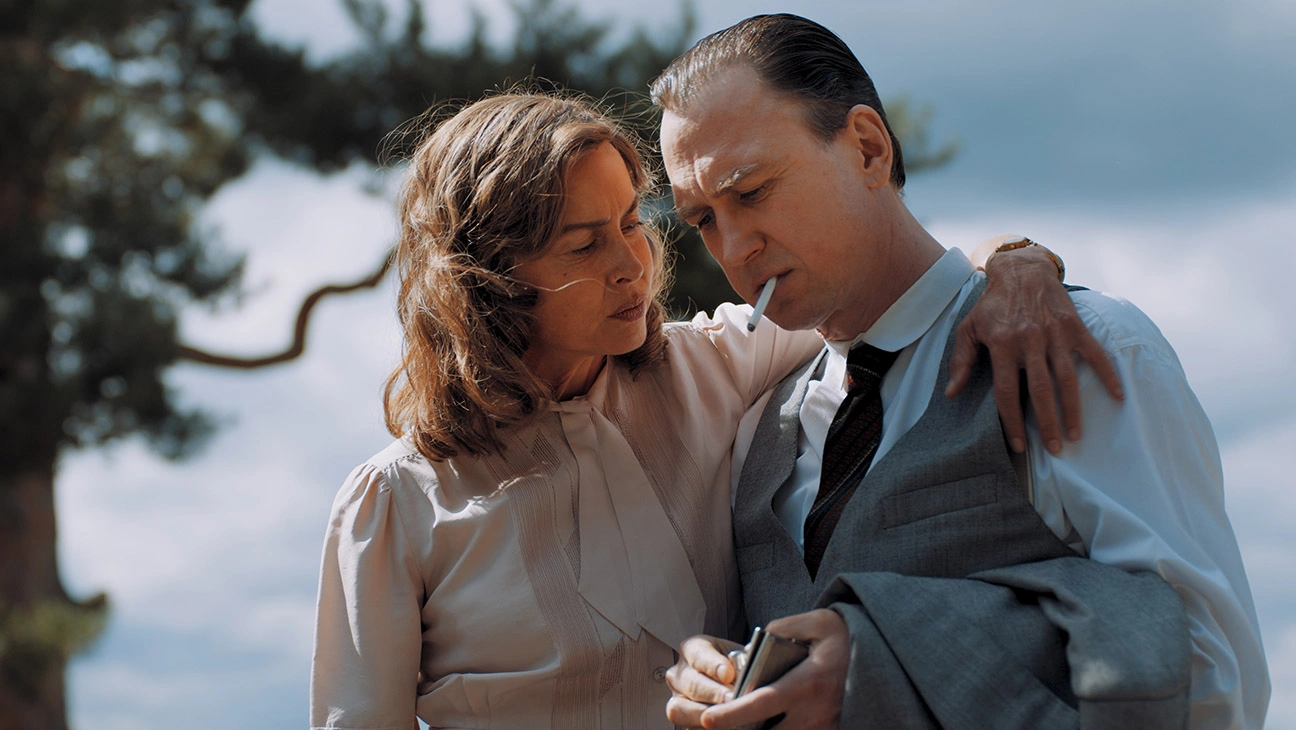
The story is built through forced handovers, a grim round of geo-political musical chairs. A brief 1920s prologue shows a wealthy farmer selling his land, splitting the paradise between two buyers in the early 1930s. Side-by-side households arise, neat in placement and poisonous in implication, as the Weimar republic breaks apart. On one plot, an ambitious architect, played by Lars Eidinger, courts Albert Speer’s favor by constructing a polished modernist home. A few meters along the shoreline, Arthur Engel, a Jewish cloth manufacturer portrayed by Ulrich Matthes, builds a modest traditional summer cottage for his family.
The calm is already infected. In the mid-1930s, state-sanctioned theft arrives through “Aryanization” laws, forcing Engel to sell his portion to his neighbor for a pittance. The Jewish family disappears onto a deportation train, leaving the hidden letters of young Doris behind. The gesture is small, paper against machinery, which makes it hurt. Bureaucracy has always enjoyed making catastrophe look tidy.
After World War II, the cycle begins again. The architect flees west, and a family of staunch communist intellectuals takes possession through political connections. Nora, an idealistic writer returning from Soviet exile, leads this new household in an effort to build a socialist utopia on stolen foundations. The phrase has the neatness of doctrine and the rot of inheritance.
Two continuities bind the periods. Nora’s granddaughter, Marija, supplies the over-arching narration. A mute gardener keeps working the soil across decades, pruning and digging under each new regime of ownership. His silence carries a bitter comic force. The deeds change hands, ideology changes uniforms, the garden still needs tending. History here is an uninvited tenant.
The Built Environment as Historical Document
Schlöndorff and production designer Sebastian Soukup treat buildings as living records, scarred by use and moral weather. Much of the film uses Albert Einstein’s actual summer home in Caputh, with its spare real-world modernist design grounding the drama in tangible space. That authenticity carries a sharp symbolic charge, since Einstein fled the same regime served by the onscreen architect. Architecture becomes evidence, and the evidence has a terrible sense of irony.
Cinematographer Axel Schneppat gives the film a clear visual grammar. It moves from a foggy black-and-white prologue into crisp, unfussy color, following the changing seasons of the lakeside idyll. The strict geographical focus places the characters inside a localized paradise as geopolitical storms gather beyond their limited horizon. Their world is small because history has made it small. That sounds like a paradox. It feels like a sentence.
The film builds historical texture through quiet set details. Archive news footage appears sparingly, and localized artifacts carry much of the burden. A masterfully constructed wardrobe contains a hidden compartment that saves a life during the chaotic passage from Nazi rule to Soviet occupation. Survival, in Visitation, can depend on the gaps inside furniture. Civilization sometimes hides in carpentry. There’s your cheerful thought for the afternoon.
Architectural Fractures and Pacing Penalties
The adaptation relies heavily on its ensemble, whose best work involves absorbing enormous historical pressure without turning into lecture delivery systems. Susanne Wolff offers a restrained portrait of resilience as the architect’s wife, surviving a brutal wartime occupation by Soviet soldiers. Eidinger gives the Nazi-aligned builder a proud, deluded sheen. Martina Gedeck gives Nora’s idealism a fine internal abrasion as socialist conviction collides with bureaucratic reality.
The final third brings a clear pacing shift. Momentum slows during the East German chapters, with the lens trained on Marija’s youth and her discovery of Doris’s pre-war letters. This section carries a particular melancholy: early revolutionary fervor drains into everyday back-scratching compliance. The revolution survives, perhaps, as paperwork with better songs.
Actually, the wide timeline demands structural sacrifice. Certain arcs, especially the architect’s post-war fate and his dealings with Speer, feel rushed and hazy. The film sometimes plods when it ought to sprint, then regains its balance in the final movement. With the Berlin Wall falling, the property receives a treatment reminiscent of Anton Chekhov’s The Cherry Orchard. Capitalism arrives, the family loses its exclusive grip on the sanctuary, and the house settles into muted resignation. History, it seems, always collects its rent.
The historical drama Visitation premiered at the Cannes Film Festival under the Cannes Premiere section. The narrative chronicles a tumultuous century of modern German history through the changing inhabitants of a single lakeside property near Berlin. Because it is a recent festival release, theatrical and streaming distribution availability will depend on upcoming regional release schedules managed by StudioCanal.
Full Credits
Title: Visitation
Distributor: StudioCanal
Release date: May 16, 2026
Running time: 118 minutes
Director: Volker Schlöndorff
Writers: Volker Schlöndorff, Jenny Erpenbeck
Producers and Executive Producers: Regina Ziegler, Volker Schlöndorff
Cast: Lars Eidinger, Martina Gedeck, Susanne Wolff, Ulrich Matthes, Josefin Platt, Stella Denis-Winkler, Michael Maertens, Ludwig Trepte, Nina Lilith Völsch, David Bennent, Angela Winckler
Director of Photography (Cinematographer): Axel Schneppat
Editors: Peter R. Adam
Composer: Bruno Coulais
The Review
Visitation
Visitation operates as a quiet, architecturally grounded capsule of generational memory. While its structural transitions occasionally feel forced, the film succeeds by treating its lakeside location as a living historical document. It is a work of dignity and craftsmanship that transforms a single plot of land into a mirror of national trauma.
PROS
- The brilliant choice to shoot at Albert Einstein's actual summer home infuses the frame with genuine historical gravity.
- The performances, particularly from Susanne Wolff and Lars Eidinger, capture nuanced psychological portraits of individuals trapped within their respective eras.
- Axel Schneppat captures the seasonal and temporal changes of the Brandenburg landscape with a beautiful, unfussy visual style.
CONS
- The final third slows considerably during the East German segments, trading narrative energy for static melancholy.
- The vast seventy-year timeline forces certain character resolutions, such as the post-war fate of the architect, to feel overly rushed.







