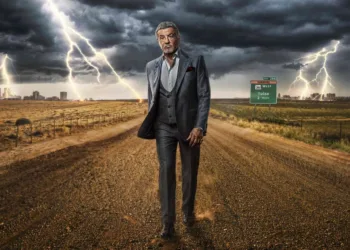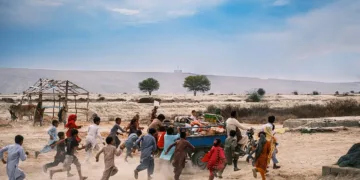


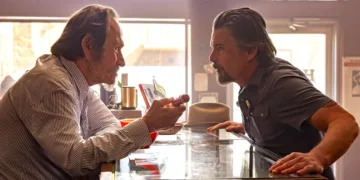







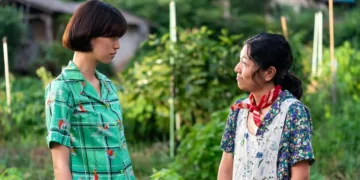














The Northwest Canadian frontier of 1874 appears as a severe, rain-darkened expanse, scrubbed clean of the soft sepia glow that historical dramas so often use to flatter the past. The series examines a community thirty years before its better-known successor began, treating origin as pressure, labor, and weather.
Rebecca Clarke and her daughter Sarah arrive after fleeing the rigid social order of Chicago for a claim of ownership that collapses almost on contact with reality. A broken wagon wheel gives their insecurity its first blunt, physical shape.
At the end of the road, Rebecca discovers that the boarding house she bought has been reduced to the bones of a building. Around her, cattle ranchers defend established interests while gold prospectors bring a feverish hunger into the territory. The atmosphere prizes mud, rain, and exposure over polished pioneer romance.
The story studies the work required to build a lasting home in land where formal authority barely holds. Rebecca meets people who embody the era’s competing methods of endurance, including a somber rancher guarding his land and a formidable trading post owner fluent in the region’s hard economics.
The Architecture of Survival
Rebecca’s arrival severs her from Chicago’s orderly social ladders. The frontier gives past rank little power against cold, hunger, mud, and chance. The wrecked boarding house becomes an image of security stolen and then forced into public view. Her decision to remain on the property gives the character a hard, deliberate dignity. She refuses the role of victim through labor and practical will.
Her former life as a doctor’s wife becomes useful knowledge in a society with formal doctors out of reach. Helping deliver a child in a crowded prospector camp opens a path toward communal trust. In this place, medical competence becomes currency, reputation, and a means of entry.
Beneath Rebecca’s industrious discipline sits the fear of her late husband’s family. Those wealthy in-laws intend to claim Sarah as property, turning Rebecca’s flight into an act of maternal self-rule. The secret sharpens her caution in the first stages of frontier life. With Tom Moore, she gains room to speak the burden aloud. Survival requires her to keep revising her own function within the settlement.
She bakes pies for Hattie’s trading post, then builds a mess tent for gold miners. Her confrontation with prospectors who have scavenged her lumber shows her tactical intelligence in full. She wins back the wood by tying their comfort to the success of her establishment. Her bond with Sarah changes under the weight of escape. The child takes on adult responsibilities and learns that freedom carries a cost visible in every board, meal, and mile.
The Social Fabric of the Wild
Tom Moore carries the solemn posture of a man protecting a way of life already under pressure. As a rancher, he sees the gold rush as a parasitic assault on land he has worked to tame. His character rests on a tension between a brooding exterior and a deep capacity for kindness. His immediate concern for Sarah’s safety reveals the protective instinct beneath his guarded manner.

He offers himself as a barrier against the dangers following Rebecca from Chicago. Practicality also shapes him. To preserve his workforce, he grants his ranch hands a day for prospecting, keeping them invested in the ranch’s future through compromise.
Hattie Quinn offers a parallel example of female self-sufficiency. She places her business and her daughter Olivia’s welfare ahead of inherited social expectations. Olivia appears as a creative dreamer, sketching the raw beauty of the frontier while nursing a private longing for a distant city. The mother-daughter bond emerges with quiet force in a moment shaped by a portrait drawn from memory.
Alexander Vaughn brings the idea of order into the valley. Fresh-faced and earnest, this Mountie tries to apply law in a territory still learning what law can mean. His attention to Olivia places him in muted rivalry with Clayton the blacksmith. His professional suspicion of Rebecca’s origins keeps the past alive as a question.
Community forms through crisis. The McCabes and other residents join a frantic search for missing children, and that shared danger alters the social temperature of the valley. Rebecca gains support by teaching Peggy to read, an exchange that frames literacy as practical power, a skill capable of shifting a person’s place in the world.
The Aesthetics of Hardship
The production design builds a tactile world from mud, timber, rain, and use. Potholes and soaked roads replace the clean trails of traditional western imagery. Heavy rain deepens the isolation of the Northwest Canadian wilderness, and the vast woods make human figures seem exposed, fragile, and temporary.
Lighting marks the distinction between the settled ranch and the volatile prospecting camps. Costumes follow late nineteenth-century norms while carrying the stains of work and weather. These clothes look worn because the world has worn them down.
Rebecca’s boarding house operates as a visual measure of her progress. Rot and damage gradually yield to repair. The Gold Rush appears through dynamite and temporary tents, signs of frantic habitation built for appetite and temporary gain. Action scenes keep returning to the physical hazards of 1874.
Wagon accidents and horse-wrangling sequences make movement itself feel risky. The search for the lost children uses darkness and forest sounds to create peril that feels immediate and bodily. The environment behaves as an antagonist, pressing against every plan and exposing every weakness.
Constructing a Common Future
The characters understand that their daily labor is building a legacy. They work toward a future they may never personally inhabit. Hope functions here as a practical instrument, a decision made under exhaustion with stern practical force.
The frontier becomes a place where inherited gender roles lose authority. Rebecca and Hattie gain property and public influence because the territory depends on their skills. Female friendship becomes essential support where institutions provide little safety.
The story keeps pressure on the clash between land preservation and mineral extraction. Tom and the prospectors reach a middle ground through respect and shared labor. Family widens beyond blood into chosen community.
Wilderness trauma binds the residents through common fear, common rescue, and common weather. Their collective identity forms through survival under the same storms. The valley becomes home because they have endured the cost of staying.
Hope Valley: 1874 premiered on March 21, 2026, as an exclusive original series for the streaming platform Hallmark+. Serving as an origin story set thirty-six years before the events of When Calls the Heart, the show chronicles the early challenges of the settlers, ranchers, and prospectors who forged the community. Viewers can watch new episodes every Thursday on Hallmark+, with the first season exploring the resilience required to thrive on the rugged Canadian frontier of the late nineteenth century.
Where to Watch Hope Valley: 1874 Online







Full Credits
Title: Hope Valley: 1874
Distributor: Hallmark+
Release date: March 21, 2026
Rating: TV-G
Running time: 45 minutes
Director: Mike Rohl, Alysse Leite-Rogers
Writers: Alfonso H. Moreno
Producers and Executive Producers: Mike Rohl, Elizabeth Stewart, Susie Belzberg, Amy Hartwick, Jimmy Townsend, Olivia Krevoy, Alfonso H. Moreno, Brian Bird, Melody Fox, Jennifer Siddle, Dattaguru Mahabal, Vicki Sotheran, Greg Malcolm
Cast: Bethany Joy Lenz, Benjamin Ayres, Jill Hennessy, Mila Morgan, Roan Curtis, Lachlan Quarmby, Ryan Robbins, Chelsea Hobbs, Brad Abramenko, Matreya Scarrwener, Neal McDonough
Director of Photography (Cinematographer): David Pelletier
Editors: Nicole Ratcliffe, Charles Robichaud
Composer: Jack Lenz
The Review
Hope Valley: 1874
This series succeeds by grounding its historical aspirations in the dirt and rain of a believable frontier. It avoids the sanitized perfection of the genre to find a rhythm within the labor of survival. Through the lens of Rebecca Clarke, the show examines the cost of autonomy and the slow construction of community. It offers a grounded perspective on the Western myth. The performances carry enough weight to balance the periodic melodrama. It serves as a grounded exploration of what it means to build a life from the ruins of another.
PROS
- Tactile production design focusing on environmental realism.
- Bethany Joy Lenz provides a grounded and resolute performance.
- Nuanced exploration of female autonomy in a lawless territory.
- Balanced pacing between personal secrets and community crises.
CONS
- Occasional leans into predictable genre melodrama.
- The central romantic tension follows a familiar slow-burn pattern.
- Certain side characters remain defined by singular archetypes.