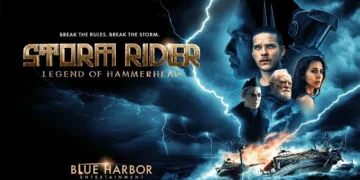
























Three hundred years after the Great Flood broke the globe into a scattered archipelago, Argos rises from the water like a lit confession of human arrogance. The city gleams as a fortress, ruled by the Founders, immortals who turn civic order into a ritual of selection.
Around it sit island nations such as Fig Island, dependent on the mercy of this luminous citadel. The annual speedboat tournament gives that mercy a savage form. A winning population gains sanctuary behind Argos’s high walls. A losing island is stripped for resources, then its people are pushed into the brine.
The arrangement has the clean brutality of bureaucracy, which may be the worst kind. Around the known world, a permanent belt of electrical storms locks the horizon in place. Ships remain inside this violent perimeter. The Founders possess the keys to the sole safe harbor left. The film frames its politics as an aquatic social contract: the leviathan has walls, polished lights, and excellent public relations, while nature answers with lightning.
The Psychic Racer and the Hammerhead Legend
At the far edge of this maritime order stands Neb, a farm boy whose history has already marked him with mythic damage. A childhood lightning strike at a sacred tree left deep scars and opened him to clairvoyant glimpses of a future that appears written across the clouds.
Trauma becomes perception. It also isolates him. His fixation falls on Hammerhead, the outlaw said to have pierced the storm and survived. For the people trapped under the Founders’ dominion, Hammerhead functions as a cipher of escape, a folk image of freedom preserved by a culture held in permanent adolescence.
Ana enters with a wound of her own. She wants to reclaim her family’s honor after her father, Lazar, died in the races ten years earlier, leaving Fig Island banned and broken. Around Neb and Ana, the supporting figures thicken the ethical fog. James Cosmo’s Dida carries the weight of a weathered moral witness.
Caroline Goodall’s Baroness sponsors Neb with cold professional poise, while concealed secrets make her generosity feel contaminated. Lord Tarus supplies the pale face of authority, pursuing the Element, a primordial energy source, as a sacred entitlement. His desire drives the plot toward the horizon. Neb becomes a vessel for a culture’s buried hopes. His arc plays like a psychological thriller wearing racing colors. Identity, destiny, and free will collide in the spray.
Steampunk Machinery and Adriatic Vistas
The film’s visual force comes from the Croatian and Serbian coastlines, whose rugged textures give the Hydroverse a physical authority. The Adriatic Sea behaves like a character: crystalline, immense, beautiful, and perfectly willing to kill everyone involved. Its depths and limestone cliffs provide a tactile reality that studio water could rarely supply.

That geography sharpens the steampunk design. The Storm Rider vessels look like machines built by people who distrust smooth surfaces. Armored hulls, aggressive spikes, and Roman-chariot menace turn each boat into a relic of industrial warfare. Metal rods draw lightning from the sky, creating a precise image of a society feeding on the chaos that imprisons it.
The camera treats these vessels as cramped moral chambers. Shot composition presses bodies against metal, rope, shadow, and salt-slick machinery. Natural light from the region gives many frames a hard contrast, while interiors lean into shadow play and chiaroscuro.
The effect places the film near noir and psychological thriller traditions, with faces cut by darkness and power rendered as architecture. Argos gleams like a stolen treasure from another age, since the production design around the islands favors a scrappy, lived-in texture. The high technology feels appropriated, guarded, and faintly obscene.
Sound design and score tighten the audience’s perception during the aquatic skirmishes. Deep brass and percussion announce the storm before the eye fully registers it, shaping dread through rhythm. Practical locations and digital enhancement meet in a tactile future. Salt, ozone, metal, and panic seem to hang in the air. Modern genre cinema often polishes away the grime. This film lets the grime do some acting, a sensible casting choice.
Narrative Rhythm and Tropes of the Sea
The adult Neb’s gravelly voiceover gives the story a historical frame, turning the immediate action into legend as it unfolds. That narration places the film in the oral tradition of heroes, failures, and storms retold by survivors. The script builds its momentum through repeated race sequences.
These bursts of speed and violence set the film’s pulse, serving as spectacle and existential test. The pattern follows the Hero with a Thousand Faces framework, complete with the call to adventure and the meeting with the mentor.
A strange tonal pressure runs through the film. Its world carries a somber meditation on survival, while the Founders bring bursts of campy villainy. Lord Tarus sneers with theatrical force near the edge of opera. The serious architecture of the setting rubs against the heightened drama of the antagonist, creating a psychological fracture that sometimes sharpens the film and sometimes makes it wobble. Villainy, apparently, still enjoys a good balcony voice.
The script explains the Hydroverse with relentless efficiency, often using dialogue to lay out rules, histories, and stakes. The revelation of Hammerhead’s identity becomes the pivot of the narrative, changing a private quest into the spark for revolution.
The final movement inside the storm is built as a sustained pressure chamber. Pacing, sound, and visual turbulence manipulate the audience’s sense of distance and danger. The film keeps the viewer moving quickly enough that the logic of Argos never receives extended inspection. Action leads. Political theory gets wet and tries to keep up.
Storm Rider: Legend of Hammerhead premiered in United States theaters on March 13, 2026, marking the launch of the ambitious “Hydroverse” franchise. Following its theatrical run, the film became available for digital streaming and VOD rental on platforms including Prime Video, Apple TV, and Fandango at Home on April 14, 2026. As of today, May 3, 2026, audiences can experience this post-apocalyptic saga on most major digital services.
Where to Watch Storm Rider: Legend of Hammerhead (2026) Online






Full Credits
Title: Storm Rider: Legend of Hammerhead
Distributor: Blue Harbor Entertainment
Release date: March 13, 2026
Rating: Rated R
Running time: 104 minutes
Director: Zoran Lisinac, Domagoj Mazuran
Writers: Zoran Lisinac, Domagoj Mazuran, Neb Chupin
Producers and Executive Producers: Neb Chupin, Allen Norg, Zoran Lisinac, Domagoj Mazuran, Marco Ilsø, Natalie Burn, George Gellert, Jessie Imundi
Cast: Marco Ilsø, James Cosmo, Caroline Goodall, Sarah-Sofie Boussnina, Billy Barratt, Joey Ansah, Ivana Dudić, Goran Bogdan, Sergej Trifunović, Gilles Geary
Director of Photography (Cinematographer): Maciej Twardowski
Editors: Alexander Harrison Jacobs, James Kondelik, Matthew Michael Ross
Composer: Lior Rosner, Erick Schroder
The Review
Storm Rider: Legend of Hammerhead
Storm Rider: Legend of Hammerhead succeeds as a tactile, ambitious experiment in aquatic world-building. While the heavy exposition and archetypal character beats occasionally drag the narrative into shallow waters, the stunning Adriatic photography and visceral steampunk design offer a refreshing authenticity. It is a work of grand contradictions: a scrappy indie project with the soul of a blockbuster epic. It captures the imagination through its sheer atmospheric weight even when the dialogue falters. For those seeking a visually arresting expedition through a ruined future, the experience is worthwhile.
PROS
- Stunning on-location cinematography that utilizes the natural beauty of the Croatian and Serbian coastlines.
- Tangible, lived-in steampunk production design seen in the detailed Storm Rider vessels.
- Ambitious and detailed world-building that creates a sense of a vast, untapped history.
- Rousing and well-executed racing sequences that provide genuine tension and scale.
CONS
- Excessive and repetitive voiceover narration that often prioritizes telling over showing.
- Over-reliance on archetypal, thin character development for the central protagonists.
- Clunky dialogue that feels burdened by technical jargon.
- Predictable narrative tropes that follow the "Chosen One" template too closely.