




























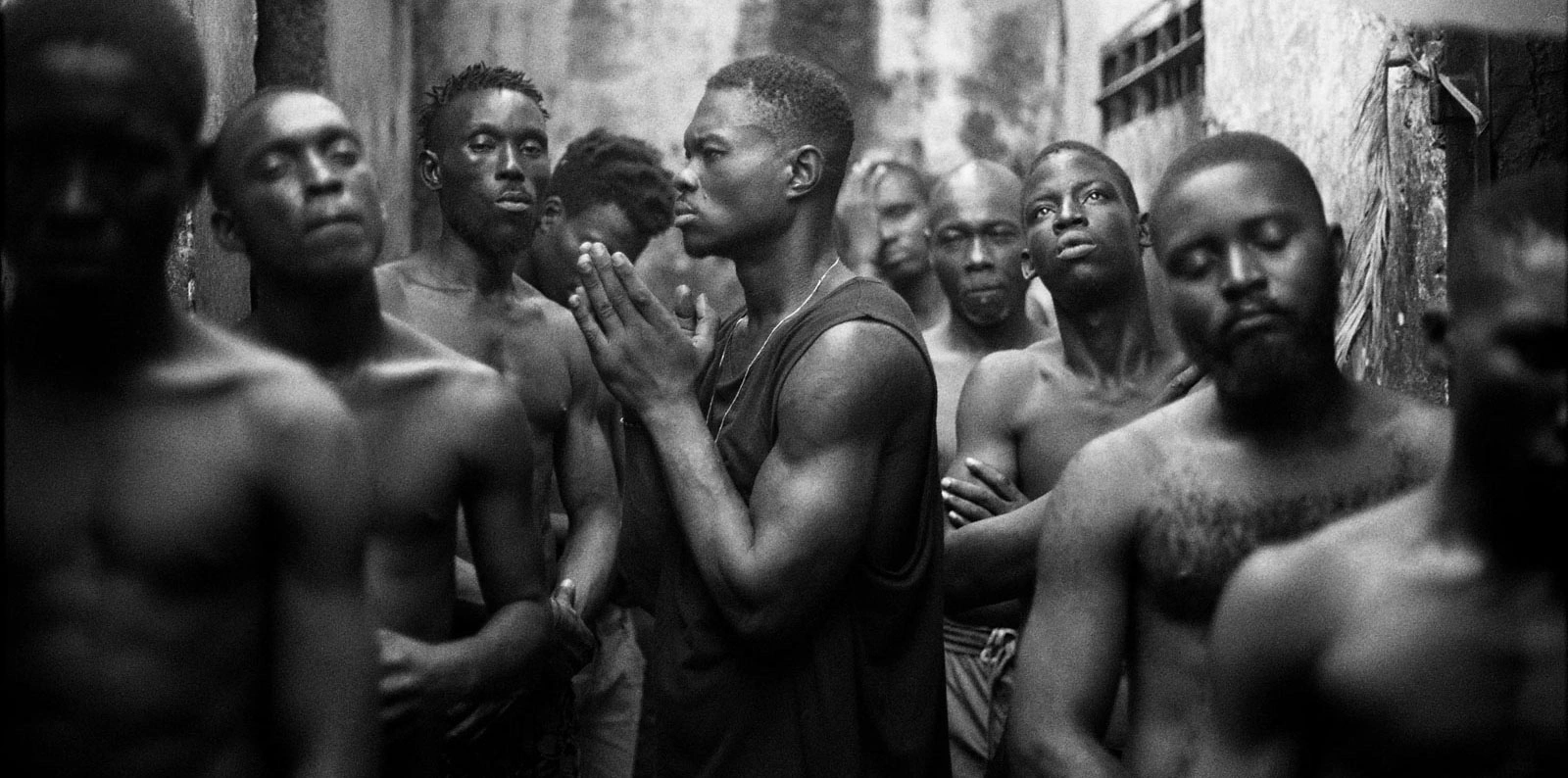
A prison yard packed far past human scale becomes a recording booth, a marketplace, a stage, and a warning in Jail Time Records. The Central Prison of Douala, also known as New Bell, was built for roughly 800 men and now holds close to 6,000. That number matters because co-directors Steve Happi and Dione Roach never let the music float free of the place that produced it.
Happi, a former prisoner and co-founder of the in-house label, brings the film a rare level of access. Roach, who worked with inmates through visual art, gives that access a visual charge that turns concrete walls, bodies, paint, smoke, and performance into the film’s working vocabulary. The result is a prison documentary that refuses the comfort of a neat reform narrative. Art matters here. So do hunger, fear, heat, status, and delay. The songs do not erase the walls. They make the walls sing back.
The Prison as a Badly Governed City
The opening sequence has the good sense to disorient us before it explains anything. Men crowd the yard, push toward food, argue over space, and move through corridors where the camera can barely find air. The handheld cinematography stays at shoulder height and often within inches of faces, which turns New Bell into a place felt through pressure rather than mapped through exposition.
La PJ, dressed with a tie and captain-style hat, becomes the closest thing to a guide. He addresses the camera with theatrical ease, explaining who sleeps where, who controls what, and why the prison runs by rules that sound absurd until the film shows them working.
His line about a place where “the mice eat the cats” gives the documentary its best structural clue. Authority has been inverted, diluted, or outsourced. Guards barely register, apart from moments such as the concert sequence, where they hover near the edge of a party they do not appear to control.
This is where the film leaves a few questions underfed. New Bell looks like a crowded town with businesses, gangs, sleeping classes, and its own economy of favors. The men nicknamed “penguins,” who sleep outside, suggest an entire social order that could fill another film. Happi and Roach choose the artists instead. It is a defensible choice, though not a painless one. The wider system keeps knocking at the frame, asking for its own close-up.
Also Read






Songs That Do Character Work
The film’s strongest storytelling comes from the way each artist uses music as a different tool. Stone, a former presidential guard nearing the end of a 10-year sentence, runs Jail Time Records inside the prison and leads the rap collective La meute des penseur.
He mentors others, then hits his own block when the page refuses him. That stalled writing matters because Stone’s songs carry what his speech cannot: his violent past, his guilt, and his desire to return to his young daughter as a different man.
Empereur is a sharper, messier study. He has the charisma of a star and the menace of someone who has learned how power operates in a place with weak official control. The scene of him practicing snarls in the mirror is funny for half a second, then revealing.
He is rehearsing threat like a performer rehearses a chorus. His afro-house tracks fold together intimidation, regret, fear, and hope, which makes him difficult to flatten into either victim or villain. The film wisely declines the flattening.
Transporteur brings the communal current. A former getaway driver waiting through a delayed trial tied to an anti-government charge, he turns upbeat, crowd-pleasing music into social currency. His songs gather men around him, creating release inside a place built on waiting. In a weaker film, this would become a tidy argument about rehabilitation. Here, music gives the inmates form, audience, and temporary command of the story. That is less tidy. It is also truer.
Editing in Rhythm, Images in Heat
Roach and Happi structure the film like an album with character tracks. Each section builds through talk, conflict, rehearsal, and then song, so the editing starts to feel musical without turning the prison into a backdrop for spectacle. The daily-life footage keeps dragging the film back to the yard, to food lines, to bare concrete, to the men sleeping under open sky. The music videos then push outward, sometimes wildly.
The homemade visuals have real force. In one Empereur video, inmates painted red and blue move around angel wings and choreographed bodies. Elsewhere, a lush jungle mural spreads across prison walls, a blunt fantasy painted on unforgiving concrete. La PJ’s smoke seeming to lift into a bird is the film’s most direct escape image, and it earns that directness because nothing else here is allowed to fly.
Some scenes are plainly staged: La PJ’s tour, Empereur’s mirror work, the videos with props and dancers. Rather than weaken the film, that staging clarifies its subject. A camera inside New Bell changes behavior, and Happi and Roach do not pretend otherwise. The men perform because performance is one of the few forms of authorship available to them. The documentary’s best insight is structural, not sentimental: in a prison where life is organized by crowding, delay, and force, a song gives time a shape.
The American-Cameroonian documentary musical Jail Time Records celebrated its world premiere at the Tribeca Film Festival on June 6, 2026, where it took home multiple top prizes, including Best Documentary Feature. The film dives into the overcrowded Central Prison of Douala in Cameroon, profiling the very first in-house recording studio built inside an African prison and following three talented, incarcerated musicians who transform their volatile reality into raw art. Film enthusiasts eager to experience the feature can follow its run across the international festival circuit or track its commercial streaming acquisition via global sales representatives at Artists Equity.
Full Credits
Title: Jail Time Records
Distributor: Artists Equity, The Agenda Collective
Release date: June 6, 2026
Running time: 94 minutes
Director: Dione Roach, Steve Happi
Writers: Documentary film (unscripted/no credited writers)
Producers and Executive Producers: Dione Roach, Steve Happi, Giacomo Stucchi-Prinetti, Tabs Breese, Taika Waititi, Rita Ora, Garrett Basch, Caitlin Alba-Rothstein, Gillian Brown
Cast: Belgie Ludrovic Abantsia, Josue Aristade Ticky Moulende, Hamadou Daibou, Dilan Nyamsi, Dione Roach, Steve Happi
Director of Photography (Cinematographer): Dione Roach, Umberto Rapisardi, Steve Happi
Editors: Jocelyne Chaput, Marie Helene Dozo, Dione Roach, Elliot Maintigneux, Pierpaolo Filomeno
Composer: Steve Happi
The Review
Jail Time Records
Jail Time Records turns prison music into sharp documentary structure, not sentimental decoration. Its best scenes let songs do the character work: Stone’s blocked writing, Empereur’s mirror rehearsal, Transporteur’s crowd-lifting performances. The film could spend longer inside New Bell’s internal economy, but its focus on authorship under pressure gives it unusual force. The walls remain. The music changes how time moves inside them.
PROS
- Immersive handheld camerawork
- Strong character-centered structure
- Powerful prison-made music
- Striking improvised music videos
- Clear-eyed view of confinement
CONS
- Prison hierarchy needs deeper study
- Some institutional context feels limited
- Staged moments may divide viewers