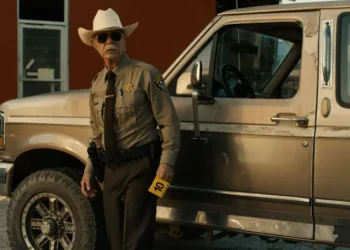











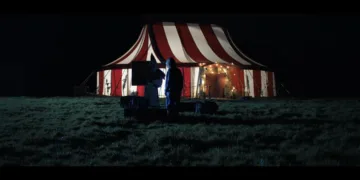
















A body falls in a Nagasaki street. The death is ugly, a messy footnote in a gangland dispute, but the camera lingers on the son who watches. This is the first performance Kikuo witnesses, a raw piece of street theatre that will become the ghost in the machine of his art. Lee Sang-il’s Kokuho opens not with the refined elegance of kabuki, but with the visceral shock of its absence.
Kikuo’s origin as a yakuza scion is not merely a backstory; it is a foundational trauma that haunts every stylized gesture and painted expression he will later master. His adoption into the kabuki house of the formidable Hanjiro is framed as a lateral move, an exchange of one brutal patriarchy for another. The codes of conduct are different, yet the demand for absolute loyalty and the swift punishment for failure are unnervingly similar.
Spanning five decades, the film documents the meticulous construction of an artist, a process so total it resembles the deliberate erasure of a soul. What begins as a search for refuge in art becomes a fifty-year exorcism, where the son attempts to purify his father’s violent legacy through a new, more exacting form of bloodshed.
The Geometry of Pain
The film grants the kabuki stage an almost holy reverence, yet it finds its true subject in the profane suffering required to get there. Lee’s camera dissects the training process with a cold, anthropological gaze. High-contrast lighting carves the apprentices’ bodies out of the dojo’s shadows, turning strained muscles and contorted limbs into living sculptures of agony.
The sound design is a symphony of discipline: the sharp crack of wooden blocks, the rustle of silk, the pained intake of breath held in a suffocating silence between the master’s commands. This is the grim geometry of pain required to achieve an effortless effect. Hanjiro’s methods are portrayed as a necessary violence, a way of breaking bone and spirit so they can be remade stronger, purer.
Kikuo’s dedication becomes a fortress of isolation, his face a blank slate upon which the onnagata is drawn. The film’s use of on-screen text to translate the plays is a curious, almost clinical choice. It provides context, yet it also creates a certain distance, inviting the viewer to analyze the performance as a text while Kikuo lives it as an open wound. The spectacle is breathtaking, but the film never lets us forget the price of its beauty.
The Double in the Looking Glass
The psychological core of Kokuho is the symbiotic rivalry between Kikuo and Shunsuke, a relationship structured like a zero-sum thriller. They are doppelgängers locked in a quiet war for a single identity: that of the master’s true successor.

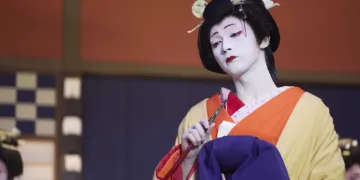
Kikuo is the interloper, a vessel of raw, obsessive talent fueled by a dark past. Shunsuke is the prince, possessing the lineage and the grace but lacking the desperate, primal hunger that drives his counterpart. Lee often frames them in tight two-shots, their near-identical makeup creating a disorienting mirror effect that erases their individual features while magnifying the emotional chasm between them.
Ryo Yoshizawa’s performance as Kikuo is a masterclass in repression; he moves with a chilling stillness, his placid exterior barely concealing the potential for violence he inherited. Every subtle shift in his eyes suggests a man at war with himself. Opposite him, Ryusei Yokohama imbues Shunsuke with a tragic humanity, his ambition constantly warring with a genuine affection for his rival.
He represents the life of balance Kikuo has forsaken. Ken Watanabe’s Hanjiro presides over this conflict with the ambiguous authority of a noir patriarch, his motivations clouded. In choosing talent over blood, he upholds the sanctity of his art, but his decision feels equally like an act of quiet cruelty against his own son.
A Meticulous Anatomy of Obsession
Lee Sang-il’s direction is a work of immense control, navigating the film’s epic timeline with a steady, unblinking focus. His camera is not passive; it is an analytical instrument. Extended takes during performances immerse the viewer in the physical stamina of the craft, forcing an appreciation for the sheer effort involved.

These sequences are starkly contrasted with jarring, rapid cuts during moments of backstage crisis, mirroring the characters’ fractured psychological states. The cinematography by Sofian El Fani paints two distinct worlds. Off-stage, the palette is muted and somber, with shadows that seem to cling to the characters. On-stage, the world explodes into saturated, hyperreal color, a space of heightened emotion that is both a release and a prison.
The editing cleverly collapses time, using subtle match cuts to link a traumatic memory from Kikuo’s childhood with a specific on-stage gesture, suggesting that his past is not something he has overcome but something he continually re-enacts.
The score blends traditional Japanese instruments with a brooding, atmospheric undercurrent, creating a soundscape of dread that persists even in moments of beauty. Kokuho is a monumental study of obsession, meticulously detailing the creation of a “national treasure” by showing us every shard of the human being that was shattered to make it.
“Kokuho” premiered on May 18, 2025, at the Cannes Film Festival. It was then released in Japan on June 6, 2025. GKids has acquired the rights to the film for a North American release in early 2026. The film is based on a novel of the same name and depicts the story of a young man who becomes a gifted kabuki performer after being adopted by a kabuki actor.
Full Credits
Director: Lee Sang-il
Writers: Satoko Okudera, Shuichi Yoshida
Producers: Shinzo Matsuhashi, Hiroyuki Araki, Minami Ichikawa, Atsuhiro Iwakami, Chieko Murata
Cast: Ryo Yoshizawa, Ryusei Yokohama, Mitsuki Takahata, Shinobu Terajima, Min Tanaka, Ken Watanabe
Director of Photography (Cinematographer): Sofian El Fani
Editors: Tsuyoshi Imai
Composer: Marihiko Hara
The Review
Kokuho
Kokuho is a monumental cinematic achievement, as meticulously crafted as the art form it depicts. It is a demanding, often emotionally cold film that rejects simple sentimentality in favor of a profound, unflinching examination of obsession. Lee Sang-il’s direction is masterful, guiding a decades-spanning narrative with breathtaking control. Through stunning cinematography and intensely committed performances, the film explores the violent geometry of pain required to create transcendent beauty. It is an unforgettable epic about the hollowing out of a man in the service of his craft, a story where the line between artistic devotion and self-annihilation disappears completely.
PROS
- Masterful, confident direction that expertly manages an epic scope and long runtime.
- Visually stunning cinematography and production design that bring the world of kabuki to life.
- Powerful and physically committed lead performances by Ryo Yoshizawa and Ryusei Yokohama.
- A deep, philosophical exploration of sacrifice, identity, and the demanding nature of art.
- An intelligent script that makes a complex, insular world feel accessible without compromising its integrity.
CONS
- The narrative sidelines its female characters, using them primarily to reflect the male protagonists' journeys.
- Its deliberate, measured pace and nearly three-hour length may prove challenging for some viewers.
- The emotionally reserved and analytical tone can create a distance from the characters' inner turmoil.