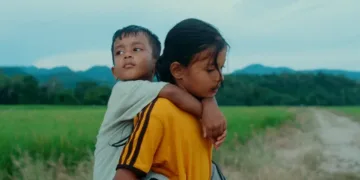

















A game of hide-and-seek opens Lost Land, and for a moment, the world feels familiar. The sound of children’s laughter is a universal comfort. Director Akio Fujimoto quickly dismantles that comfort, plunging us into the frightening reality of his protagonists. We meet nine-year-old Somira and her four-year-old brother, Shafi, two Rohingya siblings whose game is cut short by the urgent need to flee.
Their destination is Malaysia, where an uncle waits, but their path is an undefined and perilous one. The film immediately establishes its ground-level perspective, foregoing a wide political lens for an intensely personal one. It offers an unflinching look at their ordeal, creating a stark and immediate atmosphere that stays with you from the very first frame.
Through Their Eyes
Filmmakers telling stories about massive humanitarian crises often rely on exposition to give viewers context. Fujimoto bravely chooses a different path, one that represents a significant shift in how such stories can be told. Lost Land adopts a documentary-like realism, a verité style that places the viewer directly alongside Somira and Shafi, refusing to let us observe from a safe distance.

The camera consistently stays at their eye level, a simple choice with profound effects. We experience the world as they do: a chaotic blur of giant adult legs, muffled conversations in languages they do not understand, and the world seen through the grimy slats of a truck. This perspective immerses us in their confusion and fear.
By stripping away historical explanation, the film challenges the viewer to connect on a purely human level. It communicates the weight of persecution not through facts and figures, but through the immediate terror in a child’s eyes. At times, the children are visually swallowed by the desperate crowds on the boat, a stunning directorial choice that shows how easily individuals are rendered anonymous in a mass exodus.
The film’s most affecting moments come when the children steal moments to just be kids, finding a chance to play in a derelict building. This poignant contrast between their unyielding childhood spirit and the grim reality of their situation is the heart of the movie.
The Aesthetics of Survival
The film’s technical craft is inseparable from its emotional power. This is a story felt as much as it is seen, and that is a credit to its thoughtful and immersive design. Cinematographer Yoshio Kitagawa’s handheld camera creates a constant sense of instability, mirroring the precariousness of the children’s lives and denying us any sense of solid ground.

Much of the film is shrouded in deep darkness and shadow, particularly during the terrifying nighttime boat crossing where the spectacular fury of a storm feels both beautiful and deadly. This visual approach denies us a clear view, forcing us to share in the characters’ disorientation. Fujimoto, who also edits, constructs a distinct rhythm that alternates between long, observational takes and sudden, chaotic sequences of danger.
This pacing feels true to the stop-and-start nature of such a trek, where hours of tense waiting are shattered by moments of sheer panic. A simple on-screen counter marking each passing day is a brutally effective tool. With each new number, we feel the mounting exhaustion and the thinning hope. Ernst Reijseger’s musical score is used with great restraint, arriving as a jagged, dissonant arrangement of strings that amplifies the internal terror of the characters without ever feeling manipulative or sentimental.
A Cinema of Truth
What gives Lost Land its profound and lasting impact is its deep commitment to authenticity. The decision to cast Rohingya non-professional actors, speaking their own language for the first time in a feature film, is a monumental act of cinematic solidarity. It transforms the movie from a depiction of a crisis into a work that actively provides a platform for its subjects, asserting their existence in a world that has tried to erase them.

The performances, especially from the two young leads, are astonishingly natural. Shomira Rias Uddin and Muhammad Shofik Rias Uddin are real-life siblings, and their shared glances and simple gestures of protection feel entirely genuine because they are. Their presence makes the film’s events feel less performed and more witnessed. The film is a difficult experience, offering no easy resolution or catharsis. Its final moments are ambiguous and dreamlike, reflecting the deep uncertainty that defines the refugee experience. This refusal of a neat ending is a brave choice, one that respects the audience and the harsh reality of the situation. It leaves us with questions and a sense of responsibility, positioning the film as a potent and necessary statement on resilience and our shared human dignity.
Lost Land is a 2025 Japanese, French, Malaysian, and German collaboration that is notable for being the first-ever film featuring a Rohingya cast speaking in their own language. The 99-minute drama had its world premiere in the Orizzonti section of the 82nd Venice International Film Festival on September 1, 2025. While a theatrical release is to be determined (TBD), global sales rights are being handled by Rediance, though no information on streaming availability has been announced yet.
Full Credits
Director: Akio Fujimoto
Writers: Akio Fujimoto
Producers and Executive Producers: Kazutaka Watanabe, Angèle De Lorme, Christian Jilka, Sujauddin Karimuddin, Elise Shick, Mizue Kunizane, Shogo Yasukawa
Cast: Muhammad Shofik Rias Uddin, Shomira Rias Uddin, and over 200 other Rohingya people
Editors: Akio Fujimoto
Composer: Ernst Reijseger
The Review
Lost Land
Lost Land is a work of profound empathy and cinematic courage. By anchoring its narrative entirely within the subjective experience of two young siblings, the film transforms a global crisis into an intensely personal and visceral ordeal. Its unflinching realism and commitment to authentic representation make for a demanding, often devastating watch. Yet, it is this very rawness that gives the film its necessary power, creating an unforgettable and deeply human portrait of resilience against unimaginable odds.
PROS
- Remarkably natural performances from its non-professional Rohingya cast.
- A powerful and immersive child's-eye-view narrative perspective.
- Stunning cinematography and sound design that create a palpable sense of fear and disorientation.
- A vital and authentic story that gives voice to a persecuted community.
CONS
- The observational, documentary-like style may feel emotionally detached for some viewers.
- Its bleak subject matter makes it an exceptionally difficult and harrowing film to watch.
- A deliberate lack of historical context might prove challenging for some audiences.