
























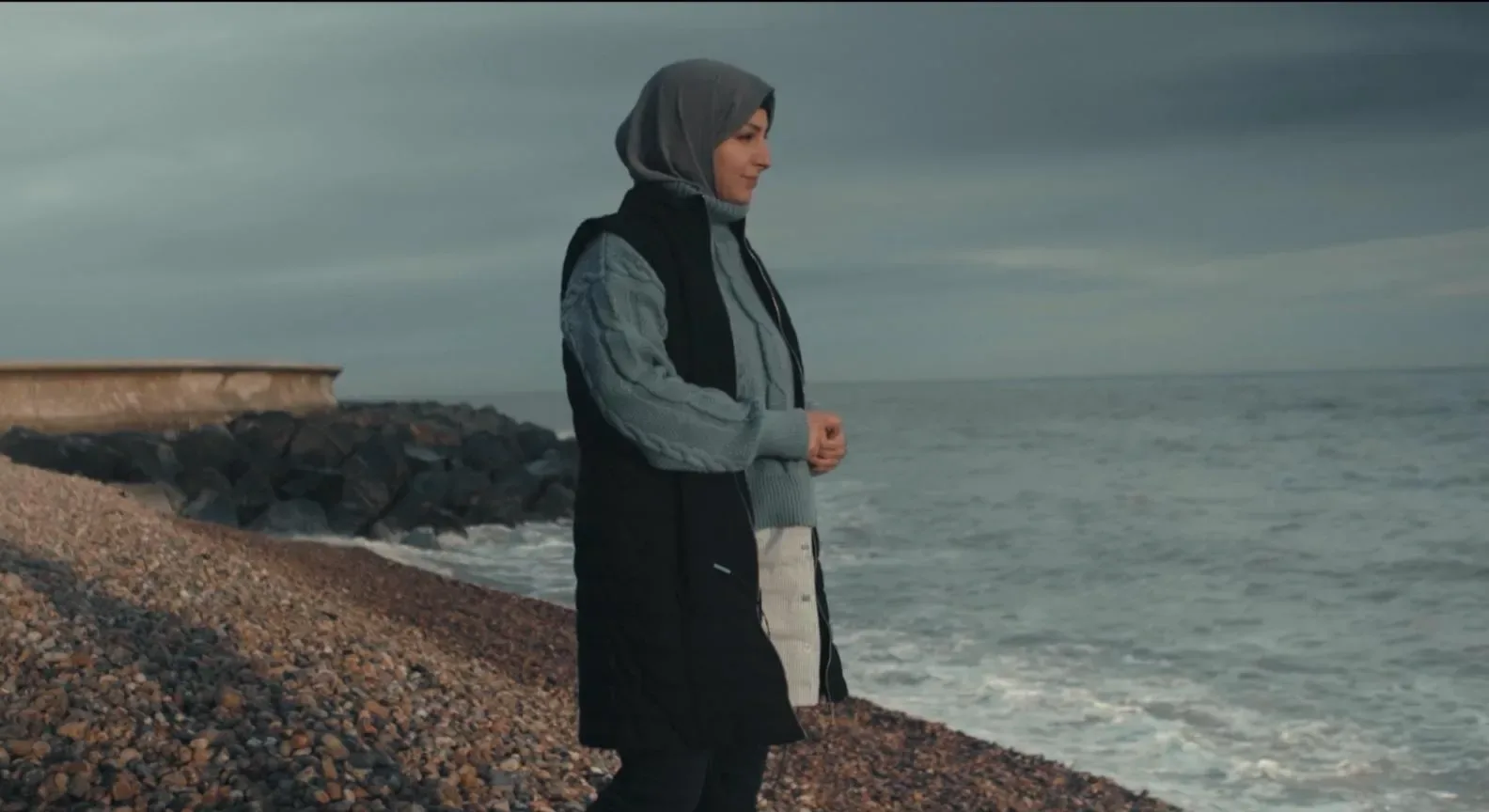

The documentary Blue Has No Borders, directed by Jessi Gutch, opens with an atmosphere of ambient tension that matches its inquiry into a fractured British identity after Brexit. The camera returns to Folkestone, Kent, a coastal town pressed up against the English Channel. The horizon reads as a mysterious and imposing threshold, a line that keeps repeating until it feels like an argument.
Location functions as character, shaped by the pressures of migration and entrenched political division. Gutch pursues the possibility of common ground within that climate. Her presence remains part of the inquiry. The point of view belongs to a filmmaker examining a place while also examining her own position in it. The result reads as social study and field diary at the same time.
The Cast of a Divided Stage
Gutch assembles a cross section of contemporary English anxieties, a set of lives that usually remain offstage. Heba, a Syrian immigrant, tries to secure cultural footing while her younger siblings move with greater ease.
Nathan, a barber, positions himself as a guardian of the working class and holds fast to touchstones like Only Fools and Horses. Josie, a Black artist and longtime resident, makes work that addresses the contested idea of who holds the land. Dan, a drag performer known as Dita, works through a non-binary identity inside an inherited working-class culture, a negotiation echoed by the tentative acceptance of an elderly father.
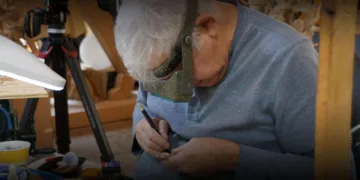
Alan and John, traditional fishermen, carry the weight of an industry in decline. Neil, a Brexiteer with friendships among asylum seekers, unsettles tidy political categories. Folkestone becomes a microcosm at the literal edge of the island, where these forces meet the gray sheet of sea.
Faces arrive in measured close-ups that hold just long enough to test our patience and our sympathy. The film treats conversation as staging, a proscenium made from barbershop mirrors, studio walls, and kitchen tables.
Also Read






The town’s shoreline acts like a chorus, always present, always humming under the dialogue. Tension and release operate here like editing beats. The pace invites identification, then interrupts it. The effect toys with audience expectation. You wait for certainty, then receive contradiction. A small joke: certainty does not live in coastal weather.
The Director’s Frame and Focus
The method is participatory. Gutch appears, engages, and shapes. Chapter markers and literary quotations segment the flow, a formal grid that adds reflective distance to lived encounter. The visual strategy leans toward the lyrical. Recurring views of the Channel turn into seascapes, wide and unreadable, charged with entropic energy. The sea does not narrate, yet it comments. That recurring image takes on the weight of structure, a refrain that keeps the argument intact.

Gutch folds her own self-questioning into the architecture. She acknowledges an initial bias and anxiety toward Neil. She records an oversight regarding the fishermen and brings that omission into the film. The move revises the expectation of documentary neutrality and pivots the project into a study of perception. Interviews provide an outlet for feeling and lived history.
They create access, then plateau. The talk often releases pressure without breaking through to a more probing exchange. The film prefers the warmth of encounter to abstract diagnosis. The trade-off stays visible on the surface, and the surface becomes part of the thesis.
The sound of conversation carries the film’s tension more than any overt musical cue. Pauses do clear work. Short exchanges arrive, then linger. Pacing moves like tide, and that rhythm governs how viewers read intent and allegiance. The frame repeats compositions that center bodies against water, harbor walls, or domestic interiors. Each placement reorients the question of belonging. The choices feel methodical rather than decorative. They assign weight to setting and treat geography as lived time.
The Denouement on the Beach
The beach dinner serves as the structural hinge, a planned meeting that draws the film’s figures into one frame. Plates, wind, a cooling sky. The design reaches for contact and civility inside the public noise of national rhetoric. The scene lands the claim that simple respect can hold in a small, shared space. Neil speaks quietly about friendships with asylum seekers. Nathan refuses reflex judgment of other people’s lives. Away from the table, Dan’s father attends Dita’s show, and a private resolution folds back into the film’s wider study of community.
The dinner arrives after careful preparation, then resolves quickly. Conversation compresses. The gathering plays as proof of possibility rather than an extended forum. The choice trims complexity and keeps the cadence even, though it reduces the depth of the exchange promised by the setup. The scene still clarifies the film’s core idea. England appears as movement rather than fixed emblem, a coexistence of strong differences that must share streets, jobs, and shoreline.
Gutch’s structure supports that idea. She cycles between the horizon and the human face, between a town mapped by industry and a town mapped by memory. The film keeps asking whether common ground can be made within that pressure. It answers with provisional contact and a record of perspective. The final impression stays modest, which suits the material. People speak, eat, and go home. The sea keeps working at the edge.
The documentary Blue Has No Borders explores Britain’s identity crisis in the post-Brexit era by focusing on the coastal town of Folkestone, a major landing point for refugees arriving from France. Filmmaker Jessi Gutch embeds herself in the community to find common ground, sharing honest conversations with six disparate local residents who embody the nation’s divisions surrounding race, class, and politics. The film had its World Premiere at Sheffield DocFest on June 20, 2025, and is currently touring various film festivals and independent cinemas in the UK. The documentary is a feature-length production, running approximately 87 minutes, and has been rated 12A in the UK for content including offensive language and references to sensitive subjects.
Credits
Title: Blue Has No Borders
Release date: World Premiere on June 20, 2025
Rating: 12A
Running time: 87 minutes
Director: Jessi Gutch
Writers: Jessi Gutch
Producers and Executive Producers: Nikki Parrott, Charlie Phillips, Mark Thomas, Natasha Dack Ojumu
Cast: Jessi Gutch, Heba, Neil, Dan/Dita, Josie, Nathan, Freddy, Harry
Director of Photography (Cinematographer): Jessi Gutch
Editors: Gladys Joujou
Composer: Ela Orleans
The Review
Blue Has No Borders
Blue Has No Borders functions best as a collection of intimate, revealing character portraits of a deeply fractured nation. Director Jessi Gutch bravely inserts herself into the process, allowing for powerful self-reflection and challenging easy political categorization. While the film shines in its visual poetics and the candid humanity of its subjects, the final gathering feels structurally incomplete. The lack of sustained, complex dialogue at the climax leaves the ultimate statement feeling underdeveloped, a missed opportunity for a deeper socio-political analysis. It is a vital document, but a slightly rushed experience.
PROS
- Captures a diverse, genuine cross-section of English life.
- Poetic focus on the Folkestone seascape and the Channel.
- Gutch's self-reflection challenges media stereotypes and her own biases.
- Uses Folkestone's geographic location as a powerful thematic device.
CONS
- The final dinner scene is truncated, shortchanging the core discussion.
- Some one-on-one conversations lack complex, searching depth.
- The film risks feeling too resolved given the severe societal splits.
- The lack of deep analysis limits its ability to be a national summary.