




























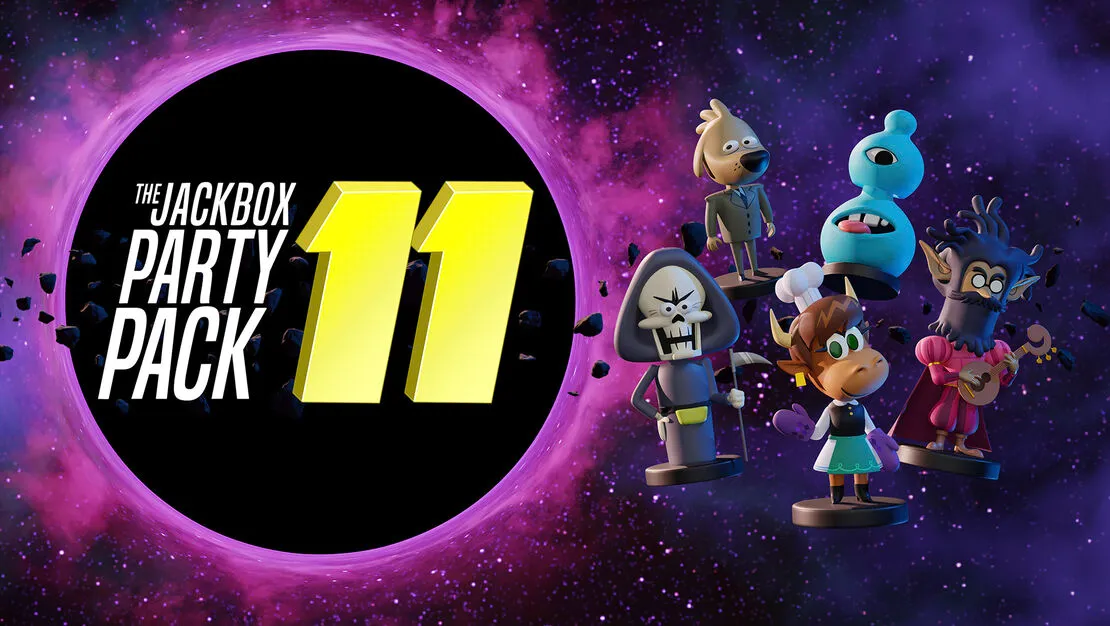

The Jackbox Party Pack series stands as a reliable annual fixture for casual multiplayer sessions. Its core approach stays clear: players skip traditional controllers and join with phones or tablets through jackbox.tv using a short room code.
The setup welcomes mixed-experience groups with little friction. The Jackbox Party Pack 11 arrives with five new games and feels like a strong set. It mixes recognizable formats with fresh ideas and presents them with a polished finish. The release signals a lively start to Jackbox’s second decade.
Repackaging Core Jackbox Mechanics
Doominate anchors the writing-and-prompt wing of the collection. Each player receives a person, concept, or phrase, then types a clause to “ruin” it. Examples include turning a “boy band” into “all addicted to meth” or making “sitting on a bench” “full of termites.” The prompt structure reliably sparks outrageous, often off-color jokes among friends.
The execution lands cleanly and produces frequent laughs. The flow leans on a familiar rhythm of creation and head-to-head votes over three rounds, including a later phase that asks players to “un-ruin” an earlier target. Several players reported that this closer feels less inventive and less engaging than the initial ruining stages.
Cookie Haus fills the drawing slot. Players act as decorators fulfilling odd client requests on cookies, then naming their creations. Icing behaves with convincing weight and spread, and the toolset covers sprinkles and multiple frosting tips. Precision drawing on a small phone screen can feel awkward without a stylus or tablet, which tilts outcomes toward the more practiced artists in the group. Even so, a scruffy drawing can still win if the joke lands.
Hear Say moves to sound. Players record a sound effect into the phone’s microphone based on a prompt such as “a werewolf eating something.” The winning audio then plays over random stock footage for an extra layer of absurdity. Volume needs and open mics introduce a practical hurdle in the same room, where ambient chatter can leak into takes and spoil a recording.
Also Read






Online sessions work better, since players can mute and capture clean clips, which preserves surprise during playback. Short minigames appear between rounds and use voice volume to move an on-screen object. These interludes can break down in a crowded living room, where nearby voices overwhelm the inputs.
The Pack’s Standout Originals
Legends of Trivia ranks among the franchise’s strongest recent trivia entries. The usual sterile question-and-answer flow gives way to a fantasy adventure that sends a party after the “Bookwyrm.” Players pick character classes with small stat differences in attack, health, and gold, evoking traditional RPG roles.
The core loop asks trivia that hits pop culture, history, and niche subjects in varied formats, including riddles, multi-answer lists, and double-answer choices. A correct reply damages the enemy; a miss dings the player. Cooperation matters because the group’s combined knowledge drives progress.
Strategy enters as the party votes on branching routes and spends gold on items or revives. The only consistent drawback is the chance of a swift defeat if the party stumbles across a few battles, which can end a run abruptly.
Suspectives supplies the social deduction slot. Players become gumshoe detectives with anthropomorphic dogs as noir-flavored avatars, and one participant receives the criminal role. A short survey opens the match, with questions like “how do you take your coffee.” After a crime card appears, the game draws one survey answer as the key “evidence.” Interrogation rounds then follow, with players questioning each other about that clue while the audience tracks suspicions.
The design feeds on shared history and habits, which helps friends bluff, trip up, or catch tiny inconsistencies. Active talk and subtle signals matter, so the format shines in person with a group that already knows one another. Newcomers can find the ruleset denser than the other games and may need a moment to settle in.
Polish, Presentation, and Practicalities
Writing and host performances carry the familiar Jackbox snap with steady jokes and confident timing. Production feels high-grade across menus, narration, and prompts. Accessibility options cover common needs, including longer work timers for streaming setups and audience voting that fits varied group sizes.
Games that feed on group chemistry and observation, such as Doominate and Suspectives, gain energy among close friends who understand each other’s rhythms. Longtime players should expect the usual light hiccups with connections now and then, which can require a quick refresh of the jackbox.tv page.
The Review
The Jackbox Party Pack 11
The Jackbox Party Pack 11 is a high-quality installment that finds its strength in novelty. Legends of Trivia successfully combines trivia with RPG elements, delivering the best experience in the series for years. Suspectives offers engaging social deduction, rewarding groups who know each other well. While Doominate is a funny, polished writing game and the pack maintains excellent presentation, the remaining games suffer from familiar formats or practical limitations. This pack is a worthwhile addition, carried especially by its innovative highlights.
PROS
- Legends of Trivia is an excellent RPG-trivia hybrid.
- Suspectives introduces compelling social deduction gameplay.
- Excellent presentation, writing, and voice acting.
- Accessible smartphone control framework.
CONS
- Hear Say is highly problematic for in-person play due to mic issues.
- Doominate and Cookie Haus use overly familiar formats.
- Suspectives can be dense for first-time players.
- Minor connectivity glitches can persist.