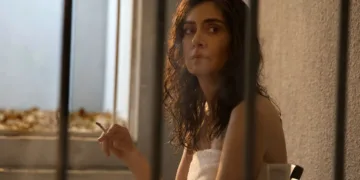












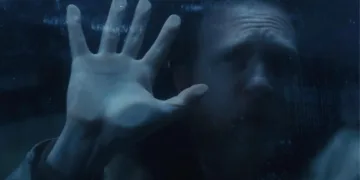





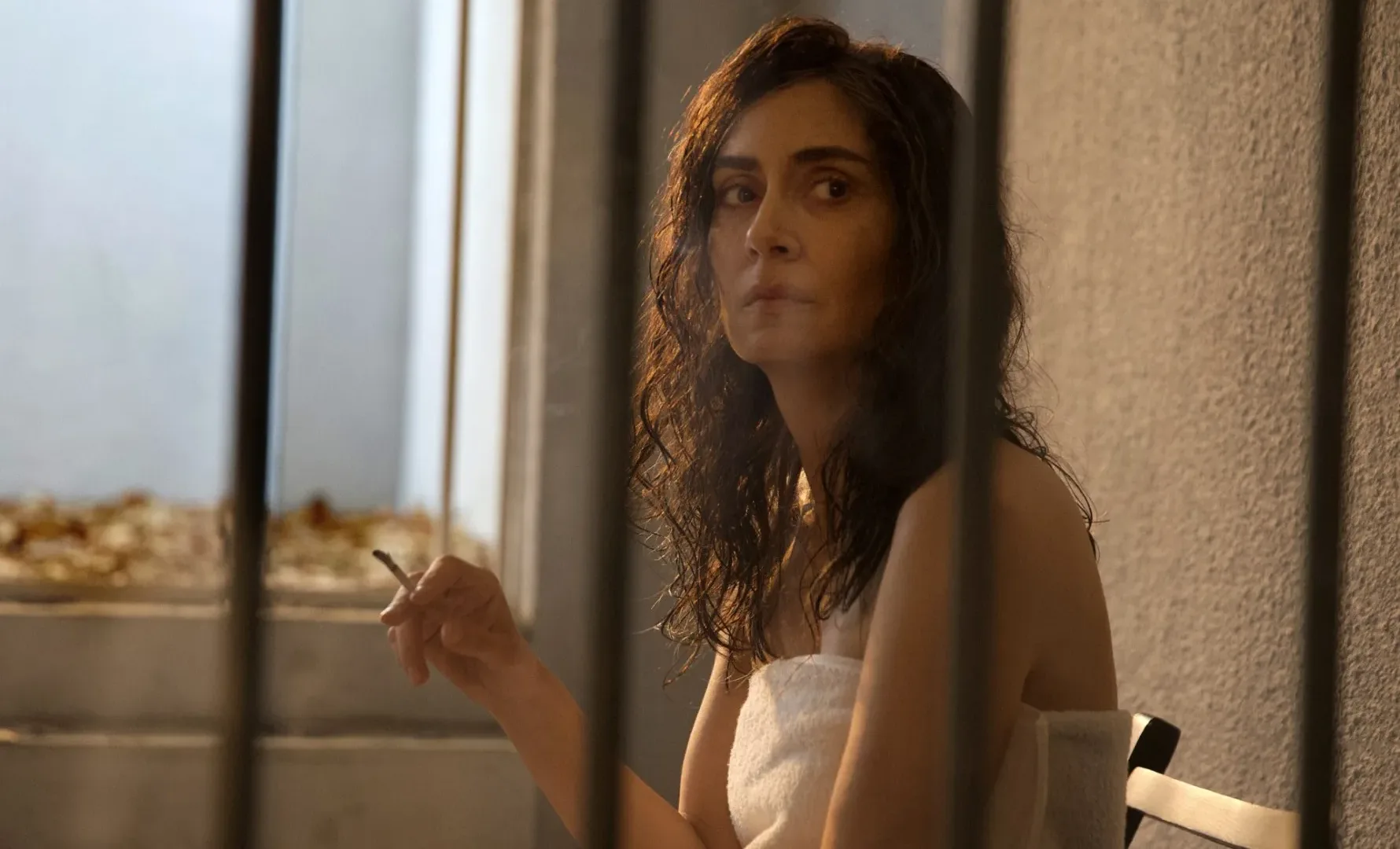

Roya, a teacher and activist, finds herself swallowed by the concrete maw of Tehran’s Evin Prison. Her world shrinks to a three square meter cube. A flickering strip light plays the role of sun. Cockroaches join her for meals. This is where Mahnaz Mohammadi begins her latest work, filmed clandestinely under the very nose of the regime it condemns. Mohammadi knows these walls personally, having served time herself for her activism.
The state presents Roya with a simple, diabolical bargain. She can leave if she records a televised confession that dismantles her own convictions. If she refuses, the cube keeps her indefinitely. Roya answers with silence so complete it starts to feel like a physical presence. She does not speak a single word across the ninety two minute runtime. The quiet reads as extreme trauma made visible.
It also reads as resistance stripped to its barest shape, a wordless refusal to lend the system the voice it wants to ventriloquize. She cannot stop the machinery around her. She can keep one territory under her control: her own mouth. The silence becomes architecture. A small, desperate structure built inside a place designed to erase personhood.
There’s a bitter historical familiarity to this setup. States have always loved the theater of confession, the ritual of forcing a person to narrate their own defeat on cue. You can hear older echoes in the demand: recant, perform, endorse the story that power has already written. Roya’s silence feels like a rejection of that script, even if it costs her everything else. It is also terrifying, because silence can be misread, weaponized, turned into “proof” by people who collect proofs for a living. The film keeps that tension alive. Silence protects her, and silence imperils her. Both ideas sit in the same room.
The Optic of the Oppressed
For the first twenty minutes, we see through Roya’s eyes. The first person perspective becomes a claustrophobic masterclass. The camera imitates her narrowed field of vision, partially blocked by a chador and a blindfold while guards manhandle her through corridors. The lens stays low, as if the world has been reduced to the floor. We catch the scuffed shoes of interrogators and hear orders snapped in severe tones. The effect is brutally practical: the viewer’s agency dissolves. We move with her stumbling gait. Each shove lands as the camera lurches. Each fall becomes our fall, the image crashing down beside her.
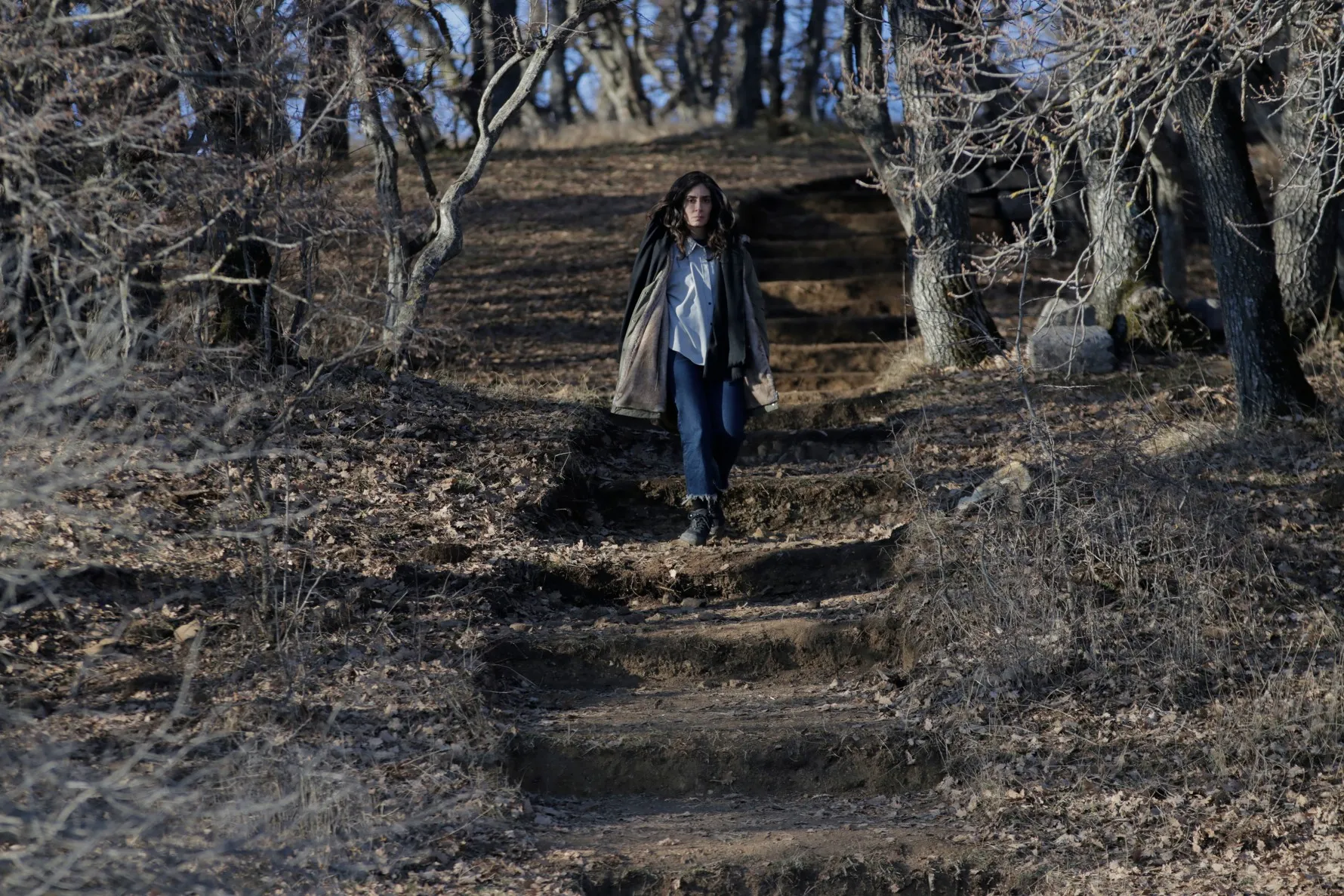
A shift arrives when Roya receives a temporary three day release. The subjective camera gives way to a more traditional cinematic style, yet the new clarity keeps lying. Ashkan Ashkani’s cinematography uses soft focus backgrounds that sustain a dazed quality, as if the outside world has been wrapped in cotton. Roya drifts through Tehran like a ghost who still pays rent. The streets feel unsteady, drowsy, slightly out of phase.
(I kept catching myself asking a petty question: does a wider frame grant freedom, or does it supply a larger cage with better lighting?) The film pushes this visual logic further as Roya begins to witness her own past actions from a distance. The image turns dissociative, a portrait of a mind splitting its own timeline to survive. The lens becomes a cartographer, tracing the rough map of consciousness while it cracks.
There’s a cultural bite here, too, in the way “release” gets staged as another form of management. The city does not heal her by existing. It becomes another surface where control can travel, quietly, politely, in daylight.
Aural Warfare and Clockwork Cruelty
Ensieh Leyla Maleki’s sound design works like psychological sandpaper. The fluorescent buzz inside the cell gains a strange heft, a noise that presses down rather than floats. We hear Roya’s heavy, ragged breathing as her hands move across the marked walls. The film treats these small sounds as evidence: proof that a person is still present, still registering pain, still trying to measure the space that contains her.
Outside the prison, sound turns into clutter, and the clutter becomes another threat. Music and the sound of a man dancing in the street carry the shape of relief, yet they slide into the mechanical noises of her apartment and produce paranoia. The crackle of a vinyl player begins to resemble static from a surveillance device. Even harmless textures gain teeth. The world keeps playing, and her nervous system keeps translating it as warning.
One scene captures the banality of evil with a chill that lands hard. An interrogator holds a casual phone call about his daughter’s birthday party while Roya suffers nearby. Domestic normalcy continues, tidy and intact, next to an act of cruelty that needs no raised voice to announce itself. It’s a slap, especially because Roya’s own family is being used as blackmail material. The film makes the point without speeches: power doesn’t require theatrical monsters. It requires administrators who can switch tones on demand.
Esmaeel Monsef’s editing abandons linearity to match Roya’s internal state. Time becomes a weapon, stretched until seconds feel like years, then crushed until months smear into a blur. Andrius Arutiunian’s drone inflected score hums underneath, a persistent low frequency vibration that refuses to let dread drain away. Once the state takes up residence in your head, the noise keeps playing. You can change rooms. You can close doors. The hum follows.
The Soldier of the Private Self
Melisa Sözen gives a performance defined by what she withholds. With no dialogue to lean on, she communicates agony through facial flickers, tiny shifts of focus, involuntary flinches that look like the body interrupting the mind. She carries a soldier like isolation, the posture of someone bracing for impact that never fully arrives because it never fully stops. Her physical presence conveys endurance as weight, as burden, as daily labor. (A skeptic could call her vacant stare too distant; my own reaction kept wobbling. Then the stare started to feel brutally true to catatonic survival.)
She flinches at the sound of a footstep even while blindfolded. The body remembers what the mouth refuses to give away. Trauma becomes choreography. The script stays quiet, and her muscles supply the testimony.
Roya’s supposed freedom reveals itself as another controlled environment. Surveillance trails her into her home. Agents haunt her apartment, pushing her to sign the confession while she tries to process news of her dying father and her deceased sister. Truth becomes a tactical resource for the state, dispensed or withheld to destabilize her. Contemporary Iran appears here as psychological horror, stripped of supernatural decoration. The monsters remain human, armed with paperwork, access, and time.
The final imagery points to the one space they cannot occupy. Her silence persists as territory that refuses annexation. It plays as a quiet victory in a war of attrition, the kind that rarely looks heroic while it is happening. Endurance, here, lives in a simple, terrifying act: remaining oneself while a system demands a replacement.
Roya premiered at the 76th Berlin International Film Festival on February 14, 2026, within the Panorama section. The film is a co-production involving companies from Germany, Czechia, Luxembourg, and Iran, including PakFilm and Media Nest. As it is currently making its debut on the international festival circuit, wide theatrical or streaming availability has not been finalized, though it is expected to be featured on curated platforms like MUBI in the future.
Full Credits
Title: Roya
Distributor: Totem Films
Release date: February 14, 2026
Running time: 92 minutes
Director: Mahnaz Mohammadi
Writers: Mahnaz Mohammadi
Producers and Executive Producers: Farzad Pak, Kaveh Farnam, Bady Minck, Alexander Dumreicher-Ivanceanu
Cast: Melisa Sözen, Maryam Palizban, Hamidreza Djavdan, Mohammad Ali Hosseinalipour, Bacho Meburishvili, Farzad Pak
Director of Photography (Cinematographer): Ashkan Ashkani
Editors: Esmaeel Monsef
Composer: Andrius Arutiunian
The Review
Roya
Roya is a grueling, essential study of the architecture of control. It sidesteps the tropes of political melodrama to focus on the sensory and psychological mechanics of state-sponsored trauma. While its formal rigour and drowzy pacing occasionally create a distancing effect, the film remains a brave, wordless scream from the heart of contemporary Iran. It is a cinematic endurance test that rewards those willing to inhabit its silence.
PROS
- A masterclass in physical acting without dialogue.
- The shift from first-person POV to traditional framing is emotionally resonant.
- An immersive aural landscape that effectively simulates psychological erosion.
CONS
- The non-linear structure and drowzy pace may alienate some viewers.
- At times, the film attempts to carry more political and familial weight than its runtime allows.
- The clinical, unsentimental direction can keep the audience at arm's length.